ENG
 VIE
 +84 9323 494 34


AI in fashion marketing: a practical playbook for fashion brands in Vietnam (with case studies)
 May 24, 2026
 Tin Le
Contents
Updated on November 1, 2026: rewritten from Adtek’s perspective for fashion marketers in Vietnam. The summary of The Business of Fashion case study has been replaced with a task map for AI, three levels of AI model imagery, a worked TikTok Shop creative example, Vietnam’s AI labeling rules and sourced 2025 market data.
In 2025, AI in fashion marketing produced two very different headlines. Zalando said generative AI cut the time to produce imagery for its app and website from six to eight weeks down to three or four days, and cut costs by 90% (Reuters via Internet Retailing, May 2025). Guess ran ads featuring AI-generated models in the August 2025 issue of US Vogue and was hammered for it on TikTok (ABC7, August 2025). The tools were roughly the same. What differed was the job AI was given, and whether shoppers were told.
By the end of this guide you will have a task map for AI in fashion marketing, three levels of AI imagery with the risk attached to each, a step-by-step creative build for a dress sold on TikTok Shop, and a labeling checklist under Vietnamese law.
Online fashion in Vietnam: why AI is worth the effort
In 2025, sales across Vietnam’s four main marketplaces (Shopee, TikTok Shop, Lazada and Tiki) reached about VND 429.7 trillion, up 34.75%. Womenswear was one of the three largest categories at VND 54.5 trillion, and kidswear grew 80.46%, among the fastest-growing categories (Metric via VnEconomy, January 2026).
Two platforms take almost all of it: Shopee 56.04% and TikTok Shop 41.31%. Products priced between VND 100,000 and 200,000 account for about 25% of sales (Metric via Dai Bieu Nhan Dan, January 2026). The channel contest between the two is covered in TikTok Shop vs Shopee.
Put those numbers together and the problem for online fashion sellers is clear. Every style comes in several colors and sizes, and every variant needs photos, short video and a description. Prices are low, so content cost per SKU has to be small. That is exactly where AI in fashion helps most.
Take a store with 120 styles in three colors each: 360 variants. At six images per variant, that is 2,160 images. At VND 100,000 per image for shooting and retouching (an assumed figure), the bill is VND 216 million before any video. Nobody reshoots everything each season, so most stores reuse old photos or supplier images, and shoppers scroll past.
Using more AI does not mean making more money. Jasper’s survey of 1,400 marketers found that 91% of marketing teams now use AI (up from 63% a year earlier), yet only 41% feel confident they can prove its ROI, down from 49% (Jasper, January 2026). At company level, 56% of the 4,454 CEOs in PwC’s survey said AI had not yet delivered higher revenue or lower costs in the past year (PwC via Search Engine Journal, January 2026). That is why the measurement section near the end matters as much as the content sections.
A task map for AI in fashion marketing
The general mechanics of AI marketing are covered in how AI marketing works. For fashion marketing specifically, the table below ranks tasks from lowest to highest risk.
| Task | What AI does | Main risk | Start when |
|---|---|---|---|
| Reading reviews and comments | Groups hundreds of reviews into a handful of shopper concerns | Low: weak summaries if data is thin | Now, even for small stores |
| Product descriptions and titles | Drafts from a template with measurements, fabric and care | Low: wrong specs if nobody checks | Now |
| Editing real photos | Background removal, backdrop swaps, lighting balance | Medium: fabric color drift | Once you have color-accurate source photos |
| Ad variations | Writes hooks and captions, cuts video into versions | Medium: many versions of the same idea | Once you can fund a test of a few million dong |
| AI models, digital twins | Puts real products on many body types | High: shopper backlash, likeness rights, labeling duties | Once review and labeling are in place |
| Fully AI-generated faces and campaigns | Creates models who do not exist, builds scenes you could not shoot | Highest: controversy, lost trust | Only when the idea genuinely needs AI to tell it |
Many teams work backwards: they jump to AI models because they look impressive and skip the first two rows because they look dull. Yet the first two rows carry the least risk and pay off fastest, because they fix the actual reasons shoppers do not buy. If I could pick only one task for this week, I would read competitors’ one- to three-star reviews.
Product photos and AI fashion models: three levels
Imagery is where AI saves the most money in fashion marketing, and where it can lose customers fastest. Splitting AI imagery into three levels tells the team which work needs careful review and which needs a label.
Level 1: AI edits real photos
Removing backgrounds, smoothing creases, matching light across a set. Under Decree 142/2026/ND-CP, technical edits that improve quality without changing the nature or main context of the content do not need a label (Vietnam Lawyers Magazine, May 2026).
The line to hold is color and fabric. Turning a beige dress ivory with AI so it looks more upmarket changes the product. The buyer sees something different from the photo, leaves one star and sends it back. Level 1 is the right place to start with AI product photography, as long as every image is checked against the real garment before it goes live. When you trial an AI fashion tool, run ten images first and put them next to the actual products.
Level 2: Real products on virtual models
At this level the garment is real and the images serve the product page: they show the piece on several body types and in several settings. H&M built digital twins of real models: the first images went out on July 2, 2025, carried a label, and the models kept rights to their likeness and a share of revenue (FashionUnited, July 2025). Zalando said about 70% of its editorial campaign images in Q4 2024 were AI-generated (Reuters via Internet Retailing, May 2025).
In Vietnam, images or video that simulate a real person’s appearance must carry an easily recognizable label (Article 11(4) of the Law on Artificial Intelligence, see the rules section below). If you build a digital twin of a real model or KOL, the contract should spell out scope, duration and payment per use.
Level 3: Fully AI-generated faces and campaigns
Here the models are not based on any real person and act as the face of the brand. Guess is the example shoppers rejected: its two “models” were created by a London AI marketing agency, and the criticism focused on two points: unreal beauty standards, and lost work for models and photographers (ABC7, August 2025).
Aerie went the other way. In October 2025, the brand pledged not to use AI-generated bodies or people in its marketing and asked its creator partners to make the same commitment. The pledge extends its 2014 promise to stop retouching bodies (Retail Dive, March 2026). Aerie still uses AI for supply chain and analytics, just not for images of people.
Shoppers want to know. Nearly 90% of consumers surveyed by Getty Images across 25 countries want to know whether an image was created with AI (Getty Images, April 2024). Brands that sell authenticity (intimates, loungewear, plus sizes) should think hard before using AI-generated models.
AI virtual try-on
Google lets shoppers upload a full-length photo to see clothes on themselves, and opened the tool in Canada in October 2025 (Google Canada Blog, October 2025). Meta expanded its test of virtual try-on in ads, showing clothing on virtual models of different shapes and sizes (Mediaweek, June 2025).
Virtual try-on is not yet common among shoppers in Vietnam. What you can do now is prepare clean, color-accurate product shots from every angle on plain backgrounds, because every try-on tool needs exactly that kind of image.
What not to do with AI imagery
- Change the color, sheen or weight of the fabric. Wrong: making a 160gsm T-shirt look like heavy cotton with AI.
- Use the face of a KOL, celebrity or former model without an agreement that covers AI use.
- Use virtual models for size charts or “real fit” photos. Shoppers pick their size from those.
- Remove or hide AI labels the platform adds. Vietnam’s AI law bans erasing or falsifying mandatory information, labels and warnings (Vietnam Lawyers Magazine, December 2025).
Worked example: a creative set for a dress on TikTok Shop
Example: a store sells a loose-fit linen dress for VND 349,000 on TikTok Shop and Shopee (an illustrative case with assumed numbers). The goal is six images, one video and 12 ad versions in one week, on a small shooting budget.
Step 1: Find shopper concerns. Paste 200 one- to three-star reviews of best-selling linen dresses into an AI tool and ask it to group them. A prompt template you can reuse:
[Role] + [Input] + [Task] + [Output format] + [Limits]
Filled in: “You are a fashion product review analyst. Below are 200 one- to three-star reviews of linen dresses. Group them into at most five concerns, with the number of reviews and two verbatim quotes for each. Present it as a table. Do not add points that are not in the reviews.”
Say the result shows four concerns: (1) the color in real life differs from the photos, (2) the fabric creases and feels thin, (3) unsure whether sizes fit petite or curvier bodies, (4) unsure whether it works for the office.
Step 2: One image per concern.
| Content | Answers concern | How it is made | AI label |
|---|---|---|---|
| Image 1: dress in natural light with a color card beside it | (1) | Real photo, AI removes the background only | No |
| Image 2: fabric close-up, crushed then released | (2) | Real photo | No |
| Image 3: size chart with the real model’s height and weight | (3) | Real photo, AI handles the layout | No |
| Images 4 and 5: the same dress on a 152 cm figure and a curvier figure | (3) | Virtual model wearing the real product (level 2) | Yes: “Illustration created with AI” |
| Image 6: dress with a blazer in an office | (4) | Real photo, AI changes the setting | Yes, because the context changes |
| 15-second video: a KOC tries it on, crushes the fabric, turns around | (2), (3) | Real footage, AI adds captions and cuts | No |
Every concern now has an answer. AI imagery is used only where real shoots are expensive (several body types, several settings), never where shoppers need the truth (color, fabric, size). The video uses a real KOC (Key Opinion Consumer) because TikTok viewers trust real experience more than an avatar.
Step 3: Multiply the ads and set a kill threshold. Have AI write three hooks based on concerns (1), (2) and (3), pair them with two opening visuals and two captions: 3 x 2 x 2 = 12 versions. Before launch, work out break-even ROAS:
- Price VND 349,000. Cost of goods VND 140,000. Marketplace and payment fees about 20%, or VND 69,800. Packing and shipping paid by the store VND 15,000.
- Profit per order before ads = 349,000 – 140,000 – 69,800 – 15,000 = VND 124,200.
- Break-even ROAS = 349,000 / 124,200 = 2.81. Any version below 2.8 once it has enough orders to judge gets switched off.
Early kill rule: any version that spends twice the profit of one order (about VND 250,000) without a sale is switched off. Testing all 12 versions costs about VND 3 million. Winners move into the main campaign, such as GMV Max on TikTok Shop.
Step 4: Label and keep records. Put “Illustration created with AI” on images 4, 5 and 6 or in the first line of the description. Keep one folder with the source photos, AI images, prompts used and model contracts in case a shopper or platform asks.
What not to do here: let AI write “premium crease-free fabric” when step 1 showed shoppers complaining about creases. Better to say plainly that linen creases naturally and two minutes of ironing flattens it, then show it in the video.
Fashion ads on Meta and TikTok with AI
In fashion advertising, platform AI already does most of the work of finding buyers. The marketer’s job is to give the system enough distinct creatives to test. How Meta picks ads by creative is covered in Meta ads in 2026: Andromeda and Advantage+.
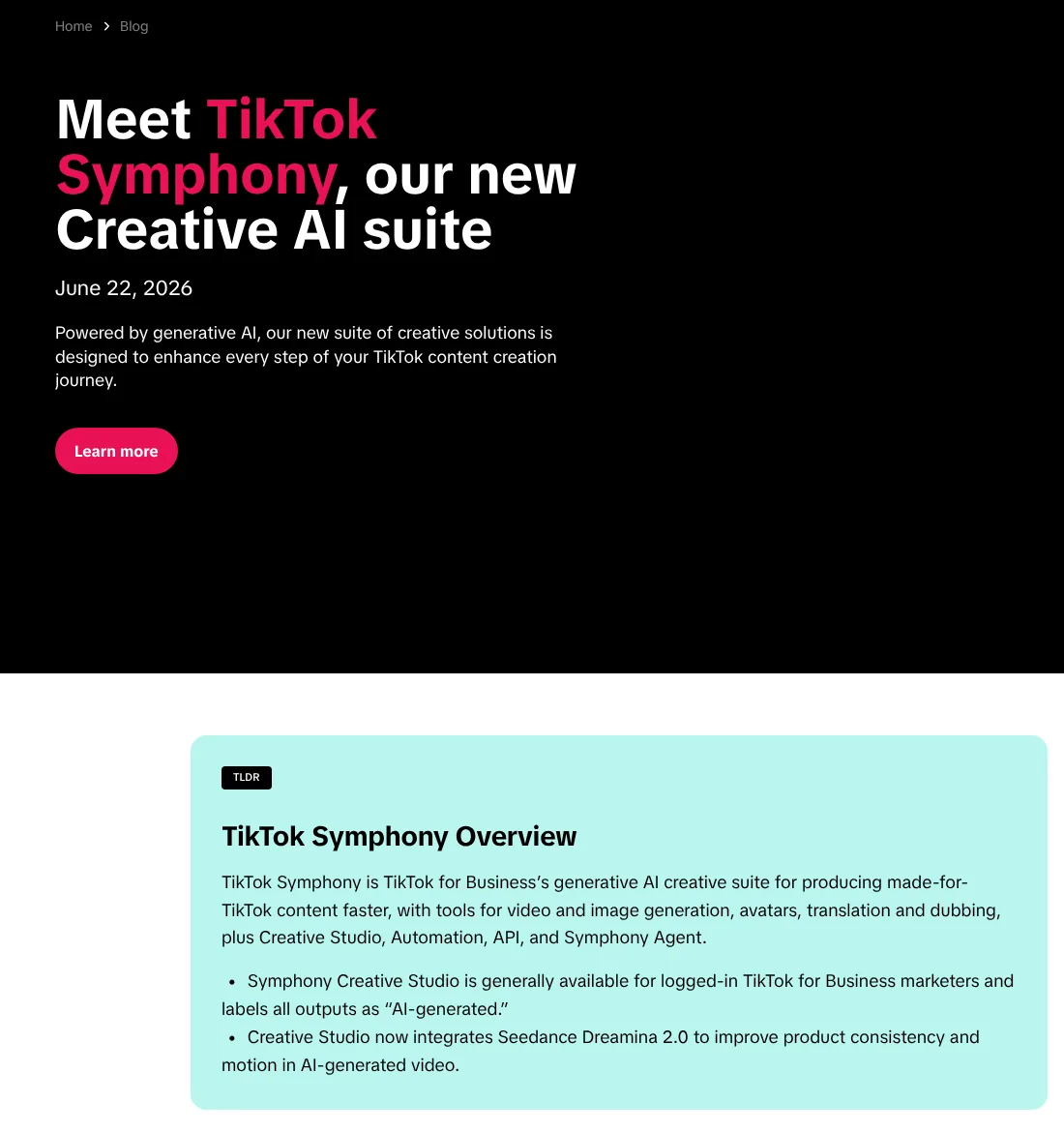
TikTok offers its Symphony suite to advertisers: video from text or images, translation and dubbing, and avatars of licensed actors who read scripts in more than 30 languages. Every video made with Symphony Creative Studio is automatically labeled “AI-generated” (TikTok for Business, June 2026).
Avatars suit videos that explain returns, sizing or care. They do not suit “try-on review” videos, because that is a testimonial from someone who does not exist. Leave testimonials to real KOCs and use AI in the edit. Tips for short video are in high-impact TikTok ads.
Run the same clothing ad long enough and CTR (click-through rate) drops while costs rise. That is creative fatigue. AI makes fresh versions quickly: new hook, new opening shot, new music, with the real product footage unchanged. For in-marketplace ads such as Shopee Ads, see retail media in Vietnam.
Product descriptions, SEO and AI search for fashion stores
Shoppers now ask ChatGPT or Gemini things like “work dresses for someone 150 cm tall” or “crease-free trousers for office wear”. Over the next 12 months, 43% of marketers plan to optimize content for both traditional and AI search (Jasper, January 2026). How to get cited by AI is covered in what AIO is and the GEO (Generative Engine Optimization) glossary entry.
For fashion content marketing, that means descriptions should answer the questions shoppers actually ask, not repeat ad slogans. A description template for AI to draft and a person to fact-check:
- Fabric and blend: “55% linen, 45% cotton”.
- Model: “160 cm, 48 kg, wearing size S”.
- Stretch, weight, lined or unlined.
- Occasion: office, weekend, beach.
- Care instructions and how much it creases.
Marketplace titles follow a formula: [Product type] + [Fabric] + [Cut] + [Occasion] + [Size range]. Example: “Linen Shift Dress V-Neck for Work and Weekend Size S to XL”. Avoid “beautiful hot trend 2026 dress” or stuffing in the same keyword five times. Data on which sources AI search tends to cite is in visibility on AI search.
CRM and repeat buyers
Selling clothes online pays off on the second and third order, because ad cost on the first order usually eats most of the margin. AI helps with three jobs: grouping customers by size, style and season; predicting when they are likely to need something new; and deciding when not to message them.
Example: a customer buys a size M linen dress in April. Instead of a weekly discount code over Zalo OA, the system suggests a jacket in the same fabric in early October through ZNS (Zalo Notification Service), already in size M. Fewer, better-timed messages lower churn rate and raise LTV (lifetime value).
The foundation is first-party data: purchase history, size and channel. Customer segmentation needs customer consent and must follow Vietnam’s personal data protection law, especially when customer data goes into outside AI tools.
Labeling AI content: the rules you need
Vietnam’s Law on Artificial Intelligence was passed by the National Assembly on December 10, 2025, with 429 of 434 deputies in favor, and took effect on March 1, 2026 (VnEconomy, December 2025). Article 11(3) and (4) place two duties on the “deployer”, meaning any organization or individual using AI in commercial activity. A fashion store using AI for ads falls in this group.
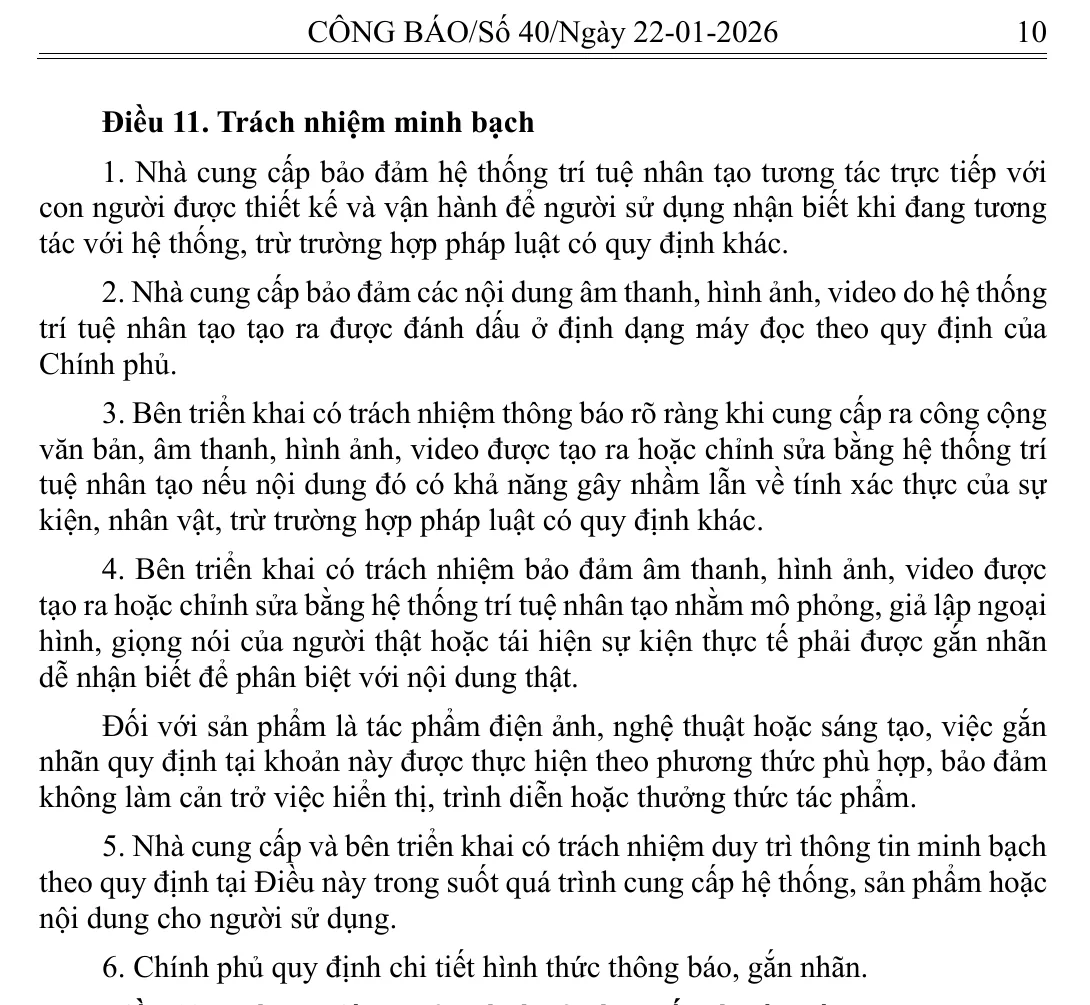
- Clearly disclose AI-generated or AI-edited text, audio, images or video released to the public when it could mislead people about real events or people.
- Put an easily recognizable label on images, video or audio that simulate the appearance or voice of a real person.
Decree 142/2026/ND-CP, in force since May 1, 2026, allows the label to sit on the content itself, in the title, description or caption, or in the platform interface. It must appear before or at the moment the viewer encounters the content (Vietnam Lawyers Magazine, May 2026).
| Case | Label needed? | Simple approach |
|---|---|---|
| Background removal, lighting balance on real photos | No | Keep the real garment color |
| AI drafts a description, a person checks it | No, if the content is not distorted | Check measurements and fabric |
| Changing the setting of a photo (office, beach) | Recommended | Caption under the image |
| Virtual models or digital twins | Yes | Label on the image and first line of the description |
| Avatars or AI voices resembling real people | Yes | Keep the platform label, do not cover it |
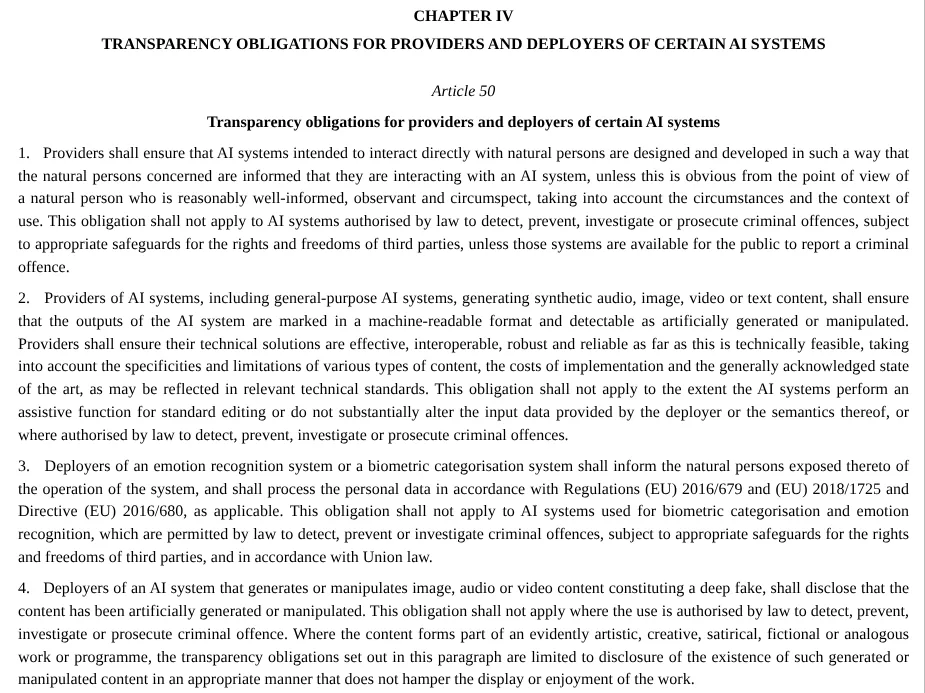
If you sell abroad, two more dates apply. In the EU, Article 50 of the AI Act applies from August 2, 2026 and requires deepfakes to be disclosed (EU AI Act, Article 50). In New York, ads featuring a “synthetic performer” must say so from June 9, 2026, with penalties of USD 1,000 for a first violation and USD 5,000 for each one after (Cooley, January 2026). The table above is practical guidance, not a substitute for legal advice on a specific case.
Measure before you scale
In fashion, judging AI on CTR alone is not enough. Polished AI imagery can pull more clicks yet push up returns if the product arrives looking different.
Example (assumed numbers): an AI image set lifts conversion rate from 2% to 2.4% on 10,000 views, from 200 to 240 orders. If the return rate climbs from 8% to 25%, kept orders fall to 180 (240 x 0.75), fewer than the old set’s 184 (200 x 0.92). Returns jump from 16 to 60, and each one costs two-way shipping. The set that “won” in the ad dashboard actually left the store worse off.
The fair comparison is a split: same product, same budget, half on real photos, half on AI-assisted images, measured until delivery is complete. Test design is covered in incrementality testing. Brands running many channels, including physical stores, can use MMM (Marketing Mix Modeling) to see the combined effect.
A 90-day roadmap for fashion marketing teams
| Period | Work | Outcome |
|---|---|---|
| Month 1 | AI reads reviews and rewrites descriptions and titles for 20 best sellers; standardize plain-background, color-accurate source photos | A list of shopper concerns by category; a reusable source photo set |
| Month 2 | Test 12 ad versions per style as in the example; trial level 2 virtual models for three styles, labeled | Break-even ROAS per style; winning versions; return rate for the AI image group |
| Month 3 | Move winners into the main campaign; set up repeat-purchase messaging by size and season | A written review and labeling process; repeat purchase rate before and after |
A fashion marketing strategy with AI does not start with choosing a tool. It starts with what shoppers worry about when they scroll past your product, then hands AI the work of answering that faster and cheaper, while the truth (color, fabric, size, real people wearing it) stays with humans.
If you want to build an AI-assisted creative strategy and run ads with measurable profit on Meta, TikTok Shop and Shopee for a fashion brand, contact Adtek.
Want to apply this to your business?
Send your question or situation. The Adtek team reads every question and gets back to you.
Prefer to chat? Message us on Zalo Categories
 Recent Posts