ENG
 VIE
 +84 9323 494 34


AI content labeling in ads: how Vietnam’s Decree 142/2026 applies
 November 17, 2026
 Tin Le
Contents
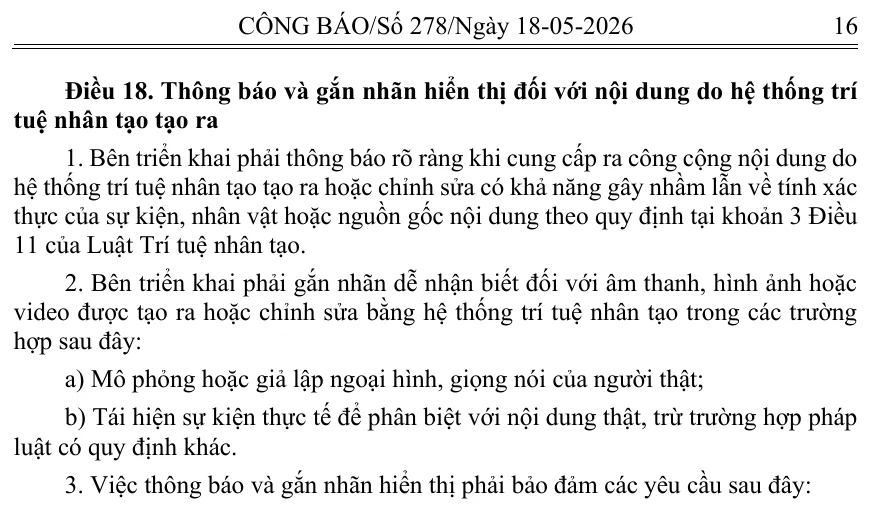
Since May 1, 2026, any ad in Vietnam that uses AI to recreate a real person’s face or voice must carry a clearly visible label. The rule sits in Article 18 of Decree No. 142/2026/ND-CP, the implementing decree for the Vietnam AI law, which sets out how AI content must be disclosed and labeled (Official Gazette No. 278, May 18, 2026). Google Ads now also lists Vietnam among the markets where AI labels appear directly on the ad.
By the end you will have a table of 12 common ad scenarios with a yes or no on labeling, the steps to switch on labels in Meta, TikTok and Google, and a 12-point checklist to run before launch. I summarize the law from the original text; where a case is still unclear, ask your legal team or a lawyer.
What the Vietnam AI law and Decree 142 say about labeling
Vietnam’s Law on Artificial Intelligence No. 134/2025/QH15 was passed by the National Assembly on December 10, 2025 and took effect on March 1, 2026 (Official Gazette No. 40, January 22, 2026). The part that matters for advertising is Article 11 on transparency. Clause 6 tells the Government to set out how labels must work, and Decree 142/2026/ND-CP, signed on April 30, 2026, does exactly that.
Think of an AI label as the “serving suggestion” line on a pack of instant noodles: you can still print a bowl piled with shrimp, you just tell the buyer it is not the real thing. The law does not ban AI in ads. It requires viewers to know when what they are watching was made by a machine.
Disclosure and labeling are two different duties
The texts separate two obligations:
- Clear disclosure (Article 11(3) of the Law, Article 18(1) of the Decree): applies to text, audio, images and video created or edited by AI when the content could mislead people about the authenticity of an event or a person. The Decree adds one more trigger: confusion about where the content came from.
- A clearly recognizable label (Article 11(4) of the Law, Article 18(2) of the Decree): mandatory for AI-created or AI-edited audio, images and video in two cases: (a) content that imitates a real person’s appearance or voice; (b) content that recreates real events.
Advertisers run into case (a) most often: AI avatars, cloned voiceovers, digital twins of a KOL. This kind of content is often lumped together as deepfakes. Case (b) catches teams that use AI video to stage a “customers queuing outside the store” scene.
Who is responsible for the label
The law puts the duty on the “deployer”: any organization or individual using an AI system in professional, commercial or service activities, excluding personal, non-commercial use (Article 3(5) of the Law). Brands and online shops that use AI to make ads fall into this group.
AI tool providers handle machine-readable marking, a hidden signal inside the file that software can detect but people cannot see (Article 17 of the Decree). For open-source or free tools, the deployer that publishes the content has to apply the marking itself (Article 17(5)).
Ads produced by an agency: under Article 18(6), the party that creates the content supplies the information and the party that publishes it applies the label. Put it in the contract: the production team declares every scene that uses AI.
Four cases that need no label
Article 18(4) exempts the following from visible labeling:
- Technical edits that improve audio, image or video quality without changing the nature or main context of the content.
- Text run through tools for spelling, grammar, summarizing, paraphrasing or translation without distorting the core meaning.
- Content used internally and not released to the public.
- Content created during research or testing in a controlled environment and not released to the public.
The word to watch in case 1 is “context”. Removing the background behind a lipstick shot is a technical edit. Placing that lipstick on a hotel vanity table generated by AI changes the context. TikTok treats background changes as insignificant edits, but a platform policy does not override the decree.
What the label has to look like
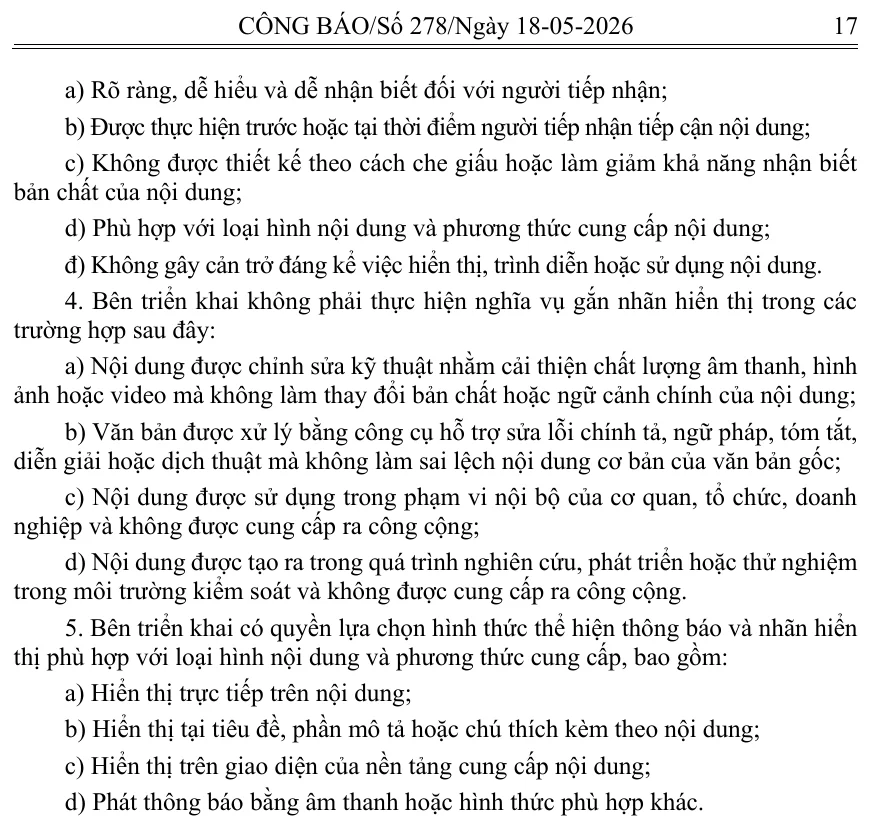
Article 18(3) sets five requirements: clear, easy to understand and easy to recognize; shown before or at the moment people reach the content; not designed to hide anything; suited to the content type; and not significantly obstructing the content. Article 18(5) lets you choose where to put it: on the content itself; in the title, description or caption; in the platform interface; or as an audio announcement.
The Ministry of Science and Technology is due to publish technical reference guidance on label formats (Article 18(7)). As of November 6, 2026 I had not found it, so check again before you lock in a label template.
What happens if you skip the label
Article 29 of the Law says violations lead to administrative fines or criminal liability depending on severity, plus compensation for any damage, with penalty details left to the Government. As of November 6, 2026 I had not seen a dedicated penalty decree for missing AI labels. Article 7 bans removing or falsifying mandatory labels, so hiding or stripping an “AI-generated” label a platform applied is a prohibited act.
12 scenarios: which ads need AI content labeling
How I apply Article 18 of Decree 142 to common situations (the “Basis” column cites the clause of Article 18):
| Scenario | Label needed? | Basis | Simplest fix |
|---|---|---|---|
| 1. Background removal, lighting fixes, denoising on a real product photo | No | Clause 4(a) | Keep the original file in case anyone asks |
| 2. AI writes or edits the caption, translates the ad headline | No, if nothing is distorted | Clause 4(b) | A reviewer rechecks benefits, prices and promotions |
| 3. Real product photo placed in an AI-generated setting | No label required; disclose if buyers could misread the product | Clause 1 | Add “setting created with AI for illustration” to the description |
| 4. AI model or virtual KOL who resembles no specific person but looks like a real photo | Label it | Clause 1; clause 2(a) unclear | Label on the image and in the first line of the description |
| 5. Digital twin of a real model or KOL | Yes | Clause 2(a) | Label on the image, image-rights contract |
| 6. Voice cloned from a real person (shop owner, KOL) | Yes | Clause 2(a) | “AI voice generated from [name]’s voice” in the caption or read at the start |
| 7. Stock AI voice that sounds like no one in particular | No label required; disclose if it plays a real customer | Clause 1 | Never let an AI voice tell “my experience” |
| 8. AI avatar built from a real actor reading a script | Yes | Clause 2(a) | Keep the platform label, add on-screen text |
| 9. AI-generated “queue outside the store” or “sold-out livestream” scene | Yes | Clause 2(b) | Better not to make it |
| 10. AI-made before and after skin shots | Do not run it, label or not | Clause 1 | Use real photos with the customer’s consent |
| 11. Animation or graphics that are clearly not real photos | Usually no | Not misleading | Label if a character looks like a real person |
| 12. AI storyboards or moodboards sent to a client for approval | No | Clause 4(c) | Mark the file name “internal” |
Row 4 is where the text is unclear: does “imitating a real person’s appearance” mean resembling a specific person, or simply looking like a real human? I label AI models anyway, because a photo-real image easily makes buyers think this person actually used the product, which falls under clause 1. How fashion shops can use AI models is covered in my post on AI in fashion marketing.
Row 6 is something I do myself: Adtek’s TikTok videos use an AI clone of my voice, so every caption carries the line “AI voice generated from Tin Le’s voice”. Row 10 is not really about labels: AI-painted flawless skin exaggerates what the product does, and TikTok’s ad policy already bans that kind of before and after comparison.
AI labels on Facebook, TikTok and Google ads
Meta: AI info sits in the three-dot menu
Meta applies an AI info label automatically when you use Meta’s own AI tools (background generation, image generation, adding animation) to create or significantly edit an image or video, and when it detects ads made with outside AI tools through C2PA, a type of metadata (information hidden in the file) that records where content came from (Meta Business Help Center). Detection of third-party tools was added in an update on June 1, 2026 (Meta Newsroom, June 2026).
The label lives under About this ad in the three-dot menu. The self-disclosure option that puts the label next to “Sponsored” is only open in Europe, California, New York, India and Taiwan, not Vietnam.
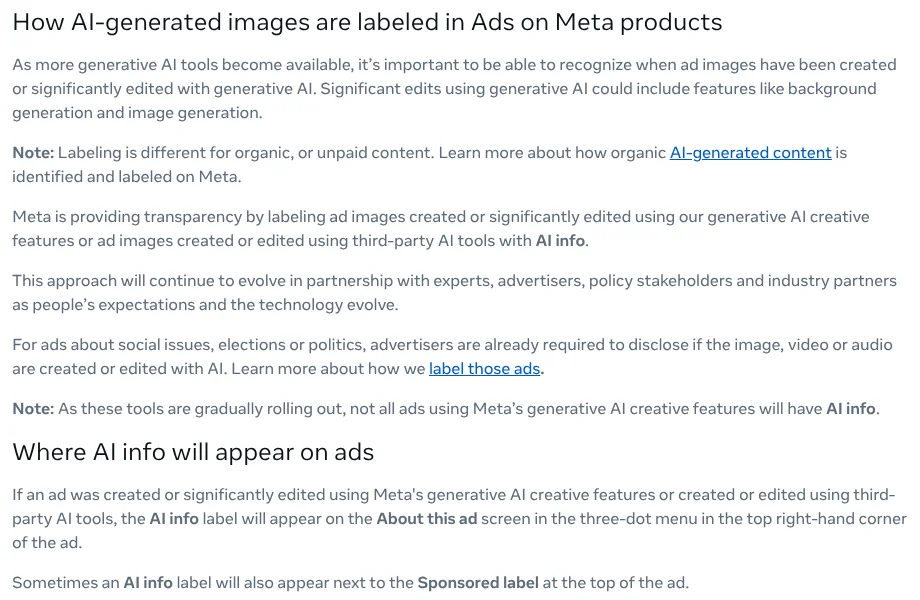
In my view, a label behind the three-dot menu struggles to meet the “easy to recognize, before or when people reach the content” test for content that imitates real people. For Meta ads with an AI model or a cloned voice, I put the label on the creative itself and in the first line of the primary text. I covered how Meta generates creative variations on its own in my post on Meta Andromeda.
TikTok: switch on the toggle or add your own label
TikTok’s ad policy (updated April 2026) allows AIGC (AI-generated content) or significantly edited media if you apply the AIGC label or add your own disclaimer, caption, watermark or sticker (TikTok Advertising Policies). “Significant” covers fully AI-generated content, showing the subject doing something they did not do, or saying something they did not say through voice cloning. Lighting, color, denoising and background changes are insignificant. Undisclosed AI content gets the ad rejected or restricted.
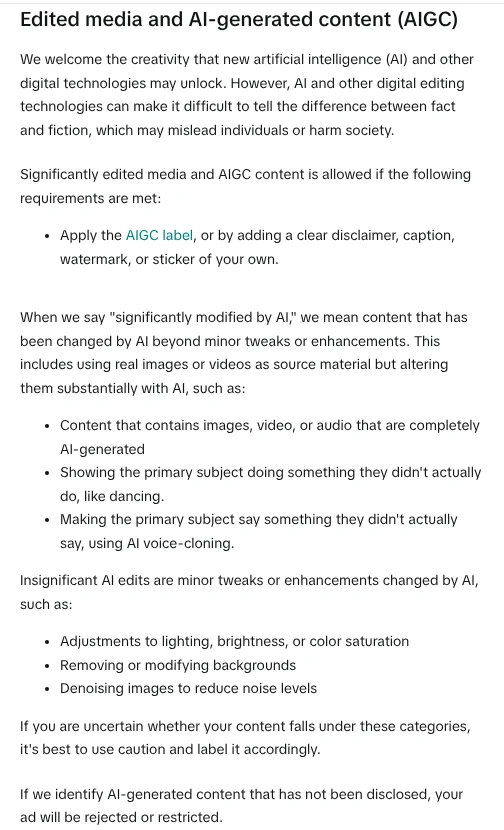
In TikTok Ads Manager, you switch on the toggle “This ad contains AI-generated content” during ad creation (TikTok Business Help Center, September 2025). Two things people forget:
- The toggle does not apply to Spark Ads. Spark Ads are organic posts promoted as ads, so the poster switches on the AI label on the original post under the Community Guidelines (TikTok, September 2026).
- Duplicating a campaign resets the toggle.
TikTok Symphony, TikTok’s suite for making ad videos with AI, includes avatars of licensed actors who read scripts in more than 30 languages. Every video made in Symphony Creative Studio is automatically labeled “AI-generated” (TikTok for Business, June 2026).
Google: labels appear on the ad itself in Vietnam
Google Ads has an AI label setting: for each asset (an ad component such as an image, video or logo), you choose “Label this asset as created or edited with AI”. Campaigns targeting Vietnam that include a labeled asset show the label directly on the ad, alongside the EU, India, New York, California and South Korea (Google Ads Help, 2026). Google announced its new set of AI labels for ads on July 9, 2026 (Google Ads & Commerce Blog).
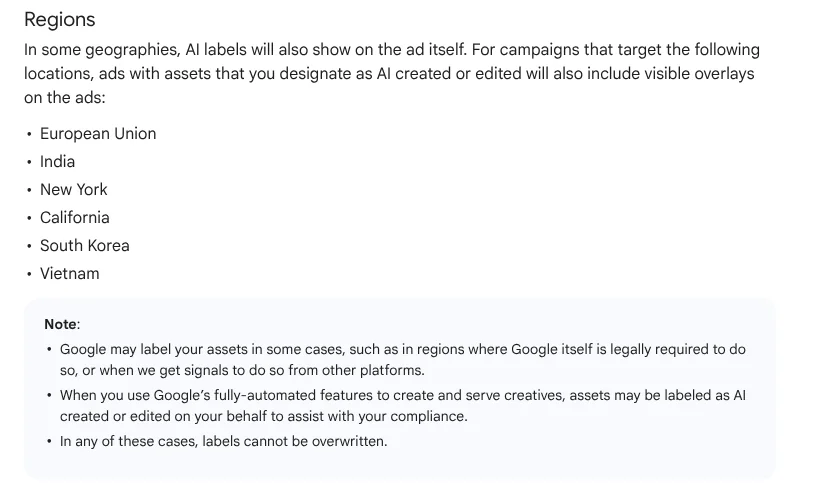
Google may apply labels itself when an asset is created by its automated features, and those labels cannot be removed. Images generated in Google Ads carry SynthID, an invisible watermark that survives screenshots, filters and compression (Google Ads Help). You may add your own label to an image without breaking the policy against text overlays; Google advises keeping it away from the edges and turning off Asset Enhancements in Performance Max so the label is not cropped.
If you run Shopping through Merchant Center, AI-generated images must keep their IPTC DigitalSourceType metadata, for example TrainedAlgorithmicMedia (Google Merchant Center Help).
Example: making an AI ad video for a serum
Example (hypothetical): a serum brand makes a 30-second video for TikTok and Meta ads, using an AI model, a voice cloned from the founder and an AI-written caption.
Step 1: List every scene that uses AI.
| Scene | Article 18 check | Decision |
|---|---|---|
| (1) Seconds 0 to 5: real serum jar, AI-generated bathroom backdrop | Clause 1 (context changed) | Add “setting created with AI for illustration” to the description |
| (2) Seconds 5 to 15: AI model applying the serum | Clause 1, possibly clause 2(a) | Label it |
| (3) Seconds 15 to 25: AI-drawn before and after skin | Clause 1 (exaggerated results) | Cut the scene |
| (4) Whole video: voice cloned from the founder | Clause 2(a) | Label required |
| (5) Caption drafted by AI, edited by a reviewer | Clause 4(b) | No label, check every benefit claim |
Step 2: Cut what should not run. I drop scene (3) entirely. An AI label cannot rescue an image that exaggerates results.
Step 3: Write the label with a formula. Formula: [Specific element] + “created with AI” + (if a real person is cloned) “from [person]’s voice/likeness”. Filled-in example: “The model and voiceover in this video were created with AI. The voiceover is cloned from the voice of Lan, our founder.” Show it on screen from second 0, readable on a phone, away from the edges, and repeat it in the first line of the caption.
Avoid:
- A tiny “AI” in a corner of the video.
- Burying #AI at the end of 10 hashtags.
- A label that appears only in the last second, after people have finished watching.
- Writing “for illustration” without saying it is AI.
- Thin white text over light skin tones.
- Only “Made with AI” in English for a Vietnamese audience.
Step 4: Switch on platform labels. TikTok: turn on the toggle for every ad using this video, including duplicates. Meta: the label is already in the video and the first line of the primary text. Google: turn on the AI label for the video asset if it runs on YouTube.
Step 5: Keep records. Prompts, tool names, original files with metadata, written consent for the voice clone, screenshots of the toggle. Article 16(2)(c) of the Decree requires keeping documents for inspection and supervision.
Checklist before running AI ads
- List every AI element: images, AI video, voice, text.
- Flag anything that imitates a real person’s appearance or voice, or recreates a real event: label required.
- Could buyers misread the product, a person or the source? If so, disclose.
- Get written consent from anyone whose likeness or voice is cloned, with scope and duration.
- Never use a public figure’s image or voice without permission.
- Do not use AI for before and after shots, UGC-style (user-generated content) reviews or results figures.
- The label shows before or as soon as people reach the content and is readable on a phone.
- The label is in Vietnamese and says which part was made with AI.
- Turn on the AIGC toggle in TikTok and recheck after every duplication; for Spark Ads, label the original post.
- Turn on the AI label in Google Ads for AI-made assets; turn off automatic image edits that could crop the label.
- Keep C2PA and IPTC metadata when exporting and compressing; never cover or crop a platform label.
- Keep records: prompts, tools, original files, consent, label screenshots.
Tasks for legal, production and media buyers
| Who | Tasks |
|---|---|
| Legal team or lawyer | Settle how “imitating a real person’s appearance” applies to AI models; review the transition period in Article 35 of the Law; draft consent templates for voice and likeness cloning; track the Ministry of Science and Technology guidance and any penalty decree |
| Production team, agency | Declare AI scenes in the handover file; deliver original files with metadata intact; keep labels away from frame edges |
| Media buyer | Turn on the toggle and AI label; check the live ad on a phone; recheck labels after every campaign duplication |
Article 7 of the Law bans processing data to run AI systems in breach of personal data protection rules, so photos and voices of staff or customers fed into AI tools need consent under Vietnam’s personal data protection law. If you plan to use an AI avatar to livestream sales, also read the livestreamer verification rules in my post on Vietnam’s e-commerce law.
If you need an AI creative workflow with labeling and risk review built in for Meta, TikTok and Google ads, talk to Adtek’s Creative Strategy team.
Want to apply this to your business?
Send your question or situation. The Adtek team reads every question and gets back to you.
Prefer to chat? Message us on Zalo Categories
 Recent Posts