ENG
 VIE
 +84 9323 494 34


The 3-second hook formula for short sales videos on TikTok, Reels and Shorts
 November 20, 2026
 Tin Le
Contents
Plenty of shops pay for a beautifully shot video with good lighting and a trending track, then spend the first three seconds on a logo and a cheerful “Hi everyone”. Viewers swipe away before the product ever shows up. The more money goes into the video, the more often the video hook on TikTok gets forgotten.
So what is a hook? It is what people see, read and hear in the first few seconds, and it has one job: make them stop scrolling. By the end you will have 5 hook formulas with examples for retail, beauty and food and beverage, a 12-point checklist to test a hook before you put ad spend behind it, and a way to read the metrics using each platform’s own definitions.
What a video hook is and why the first 3 seconds decide a short video
A hook is the opening of a short video whose only task is to make a scrolling viewer stop. Advertisers call that moment the thumb-stop. Think of a fruit seller at a Vietnamese wet market: shoppers walking past give each stall about one second. The seller who calls out “Hoa Loc mangoes, money back if they’re not sweet” gets people to stop. The one who says “Come take a look” does not.
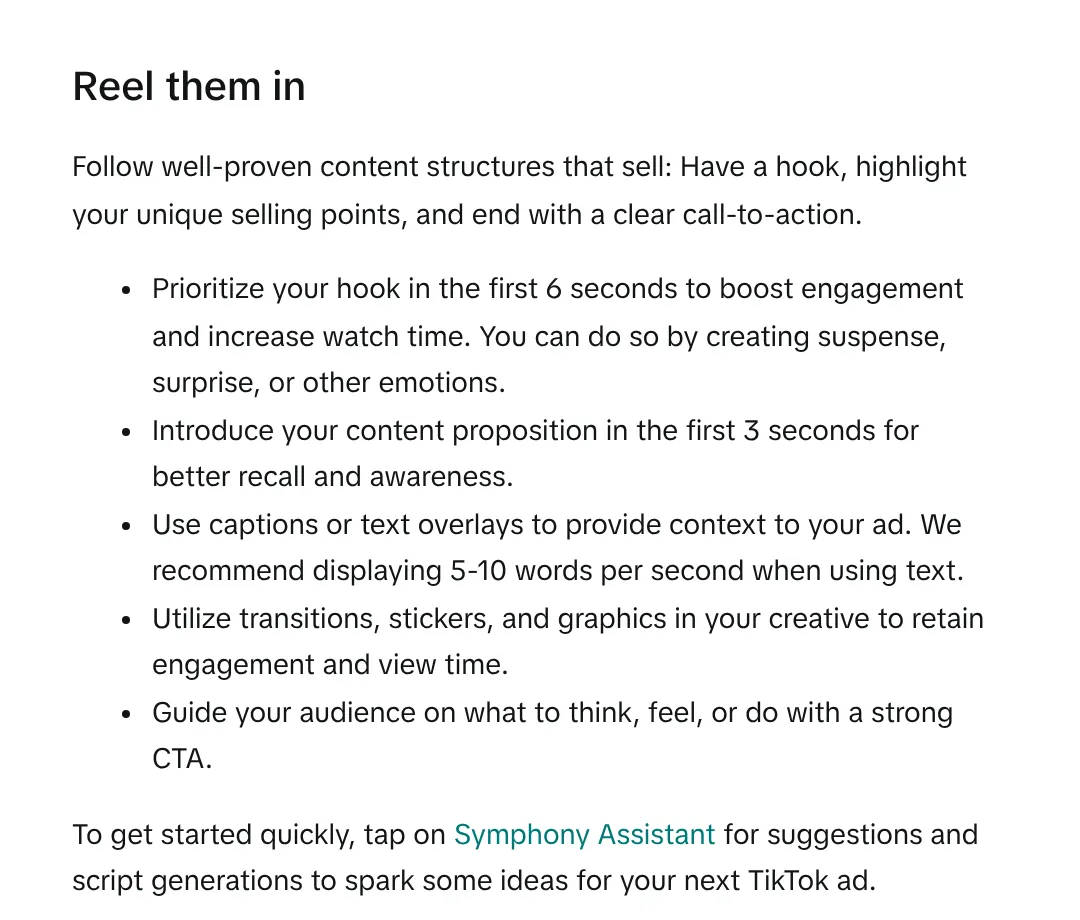
The 3-second figure is not something practitioners made up. TikTok recommends placing the hook within the first 6 seconds to lift engagement and watch time, and introducing your content proposition in the first 3 seconds for better recall and awareness (TikTok Business Help Center, June 2025). The structure TikTok suggests is a hook, then your unique selling points (USP), then a clear CTA at the end.
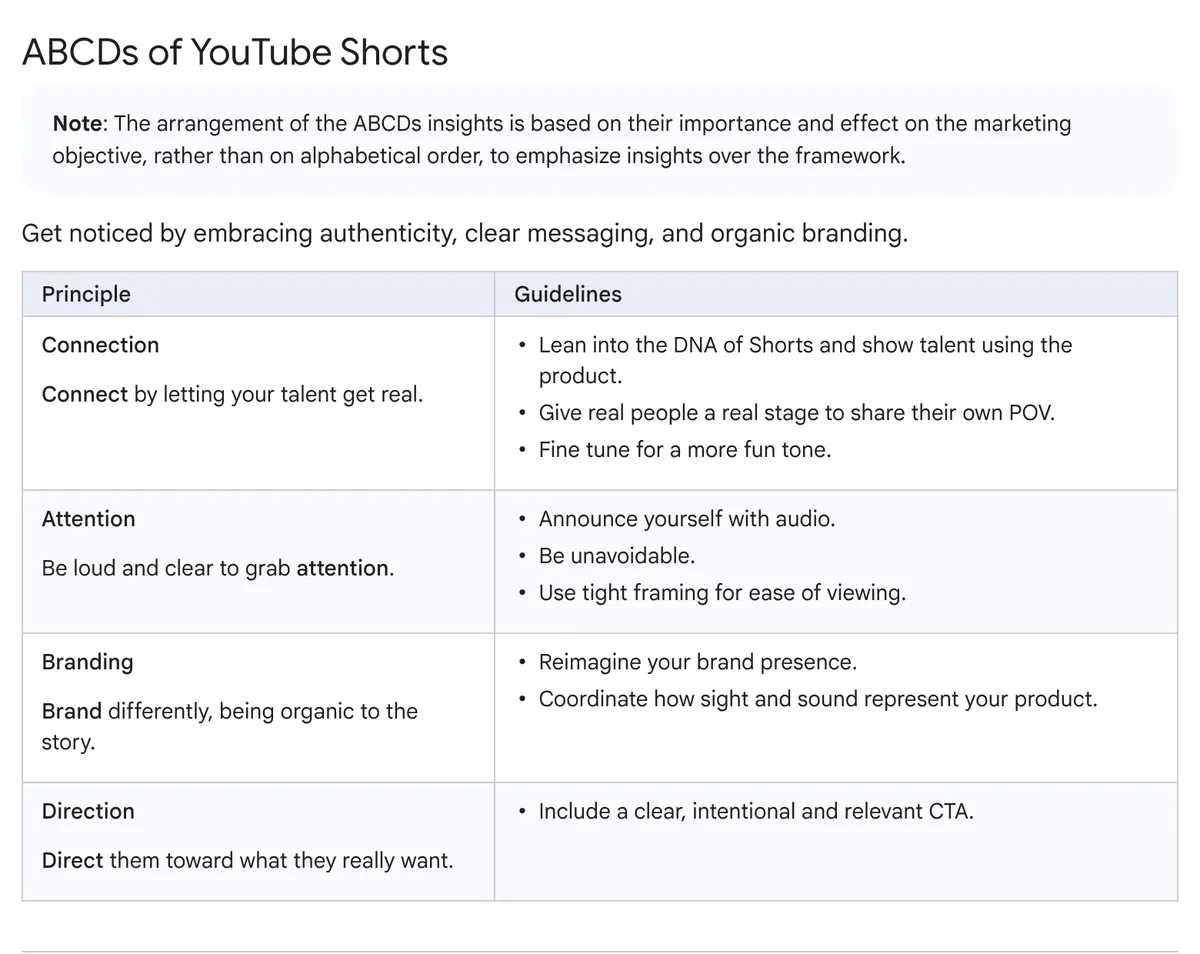
For Instagram video ads, Meta recommends putting the brand and key message in the first 3 seconds and using motion or a striking visual in the very first frame (Meta Business Help Center, accessed November 2026). Google calls this Attention in its ABCD framework for YouTube ads, without naming specific second marks: jump into the heart of the story, keep the pacing fast, frame tightly. The way I remember it: 3 seconds for the viewer to understand what the video is about, 6 seconds to keep them there.
How a TikTok video hook differs from Reels and Shorts
All three platforms use vertical 9:16 video and all three reward a strong opening. The differences come from viewing habits: whether people watch with sound on, and where on-screen text can safely sit.
| Platform | What the official guidance says | What it means for your hook |
|---|---|---|
| TikTok | Hook within the first 6 seconds, content proposition within the first 3; use sound or music, shoot vertically at 9:16, at least 720P, keep content inside the UI safe zone | On-screen text at 5 to 10 words per second; real people, a DIY, not overly polished look |
| Facebook Reels, Instagram Reels | Brand and key message in the first 3 seconds; most people watch with sound off; 6 to 15 second videos work better in feed and stories | Subtitles; large text placed in the middle of the screen; keep the edges clear |
| YouTube Shorts | Announce yourself with audio, be unavoidable, use tight framing; show real people using the product; a clear CTA | A spoken line from the first frame; branding woven into the story |
TikTok: sound and real people
For a TikTok hook, TikTok wants the ad to feel made for TikTok: creators, employees or customers on camera, and a self-shot style that sits naturally next to UGC videos. The hook can come from suspense, surprise or another emotion, supported by text overlays that give the viewer context (see the “Reel them in” section in the screenshot below).
Facebook Reels: design for sound off
For 9:16 video in Reels and Stories, Meta advises keeping the top, bottom and side edges free of key elements so text and logos are not covered by interface items such as the profile icon or the call-to-action button. If a Reels ad carries a disclaimer, leave the bottom 40% of the frame free (Meta Business Help Center, accessed November 2026). A hook on Facebook Reels should therefore sit in the middle of the screen and make sense with the sound off.
YouTube Shorts: speak up immediately
Google’s separate ABCD table for YouTube Shorts puts Connection first: real people using the product, telling it from their own point of view, in a more fun tone (see the screenshot below). A Shorts hook should have someone speaking from the first frame, with a face or the product filling most of the screen.
5 hook formulas for short sales videos
Every hook has three layers: the visual (what people see), the text (the line on screen) and the audio (the first thing said). Meta splits hooks into exactly these three layers and lists text hook types such as dramatizing the problem, asking a question, starting with skepticism, a negative statement and teasing a promise (Meta Business Help Center, accessed November 2026). I group them into 5 formulas for sales videos. All examples below are hypothetical and set in Vietnam, with prices in VND.
1. The problem hook
Formula: [An annoying situation the customer is in] + [a sign they recognize instantly]. Open on the annoying moment itself; the product can wait.
- Retail: a white shirt with a yellowed collar, text “White shirt, worn 3 times, collar already stained?”
- Beauty: a close-up of an oily face at 2 p.m., voice “It’s only 2 p.m. and my face looks freshly fried.”
- Food and beverage: an iced coffee gone watery, text “Takeaway coffee: by the time you reach the office, it’s just ice water.”
2. The result hook
Formula: [A result people can see] + [a specific time or condition]. The result has to be filmed for real, not just claimed.
- Retail: a tumbler dropped onto the floor, text “Fell off the desk, lid still sealed.”
- Beauty: one swipe of makeup remover clearing waterproof mascara, voice “One swipe, no scrubbing.”
- Food and beverage: a banh mi cut in half with the filling spilling out, text “A VND 25,000 banh mi with this much filling.”
For beauty products, I avoid before-and-after skin hooks until I have read the advertising policy of the platform I am running on, because that format is easy to get rejected.
3. The comparison hook
Formula: [The old way the customer uses] vs [the new way], side by side in the same frame. A split screen lets people get the point before they read a word.
- Retail: a hand-wrung mop on the left, a self-wringing mop on the right, text “Mopping a 50m² apartment: 15 minutes vs 6 minutes.”
- Beauty: two sunscreens on the backs of two hands, voice “Which one leaves a white cast?”
- Food and beverage: milk tea at 100% and 30% sugar side by side, text “Same price, here’s the difference.”
4. The question hook
Formula: [A question the customer is already asking] + [a promise to answer it in the video]. It has to be a question customers really type into search or ask in the comments.
- Retail: “Is a 5-liter air fryer big enough for a family of 4?”
- Beauty: “Can oily, acne-prone skin use a cleansing oil?”
- Food and beverage: “Fried chicken left overnight: does it stay crispy when you reheat it?”
5. The pattern-break hook
Formula: [A visual or line that contradicts what the viewer expects], then a fast link to the product by second 2 or 3. This is the “surprise” hook TikTok mentions.
- Retail: the shop owner cuts one of the backpacks they sell in half, voice “I cut a VND 600,000 backpack in half so you can see inside.”
- Beauty: text “Don’t buy this serum unless your skin is dry.” (a negative statement, one of the types Meta lists)
- Food and beverage: a chef pours a whole pot of broth away, text “This batch came out wrong, so we won’t sell it.”
Finding hook ideas in TikTok Creative Center
TikTok suggests opening TikTok Creative Center to browse trending hashtags, creative insights and the Commercial Music Library (music cleared for ads). The Top Ads section shows high-performing auction ads and can be filtered by region, objective, time period, language and ad format. I only watch the first 3 seconds of 20 ads in the same category and note which of the 5 types each one uses. For a starting draft, Symphony Assistant inside TikTok Symphony suggests ideas and generates video scripts.
Example: writing hooks for a 20-second tumbler video
Say I need a video ad for a 500ml insulated tumbler priced at VND 290,000 (hypothetical), running on TikTok Ads and Facebook Reels. I work through 5 steps.
Step 1: read the 1-star and 2-star reviews of similar products. After reading about 50 bad reviews across 3 shops selling tumblers on a marketplace, I pull out the 3 complaints that come up most: (1) ice does not last as long as advertised, (2) the lid leaks and soaks the bag, (3) there is a plastic smell on first use.
Step 2: turn each worry into a hook, each hook a different type.
- Hook A (result, answers worry 1): pouring out ice at 8 a.m., text “Ice in at 8 a.m., still there at 5 p.m.”
- Hook B (pattern break, answers worry 2): a full tumbler set upside down on a laptop, voice “I’m brave enough to put this upside down on my laptop.”
- Hook C (question, answers worry 3): a close-up of someone sniffing the rim, text “Does a brand-new tumbler smell like plastic?”
Step 3: write all three layers for seconds 0 to 3. For hook B, the visual is the upside-down tumbler on the laptop in the first frame, with no logo and no greeting. The text “Upside down on a laptop for 1 hour” sits in the middle of the screen, away from the bottom edge. The spoken line lands in the first second for people with sound on in TikTok and Shorts, while sound-off viewers on Reels can still read the text.
Step 4: keep the body of the video fixed and swap only the hook. The video script after the hook is the same for all three versions:
| Seconds | Content | Purpose |
|---|---|---|
| 0 to 3 | Hook A, B or C | Stop the scroll and make clear what the video is about |
| 3 to 6 | Immediate proof: lift the laptop, completely dry | Carry viewers past the 6-second mark |
| 6 to 14 | Three differentiators: double-wall steel, gasketed lid, 3 colors | Answer worries (1), (2) and (3) |
| 14 to 20 | Price VND 290,000, text and voice “Tap the cart to pick your color” | A CTA in both text and voice |
The body answers all three worries; the hook only decides which worry leads.
Step 5: run the three versions as three separate ads. TikTok recommends 3 to 5 creatives per ad group and, when testing, creatives that differ significantly from each other (TikTok Business Help Center, June 2025). This is a simple A/B test: the body is identical, so any gap in the metrics comes from the hook. On Meta, Meta Andromeda also needs genuinely different creatives to find the right viewers.
Checklist: test your hook before running ads
Watch the video on a phone, once with sound off and once with sound on, and tick each line. If 3 or more lines are missing, go back to the hook.
- The first frame already shows a person, the product or the problem, not a logo or a black screen.
- After the first 3 seconds, a stranger can tell you what the video is about.
- The hook is tied to one specific worry or desire of the customer.
- It still makes sense with sound off: there is on-screen text or subtitles.
- With sound on, the first spoken line arrives within the first second.
- On-screen text stays at or under 10 words per second and can be read in one pass.
- Text and faces sit inside the safe zone, not covered by buttons or the account name.
- The video is vertical 9:16, well lit, and at least 720P for TikTok.
- The product or brand appears within the first 3 seconds.
- Seconds 3 to 6 prove what the hook just promised.
- There are at least 3 hook variants of different types for the same body.
- The closing CTA is both written and spoken and tells viewers exactly what to do.
What not to do when writing a hook
- Open with a greeting: “Hi everyone, today I’m going to review…” Viewers have no reason yet to keep listening.
- Open with a 2-second logo intro. Google does recommend showing the brand early, but inside the story.
- Use clickbait unrelated to the product: “I just lost VND 100 million!” and then sell phone cases. Viewers feel tricked by second 4.
- Cram the text: “Premium 304 stainless steel double-wall tumbler keeps hot and cold 12 hours genuine best price” in 2 seconds.
- Put text right at the bottom of the screen, where the Reels and TikTok interface covers it.
- Use one hook for every channel: the Reels cut needs text for sound-off viewers, the Shorts cut needs a spoken line in the first frame.
Which metrics measure a hook
“Thumb-stop” and hook rate are practitioner terms, not column names in an ads manager. Each platform counts early views with its own definition, so only compare hooks within the same platform.
| Platform | Metric | Platform definition | What it tells you |
|---|---|---|---|
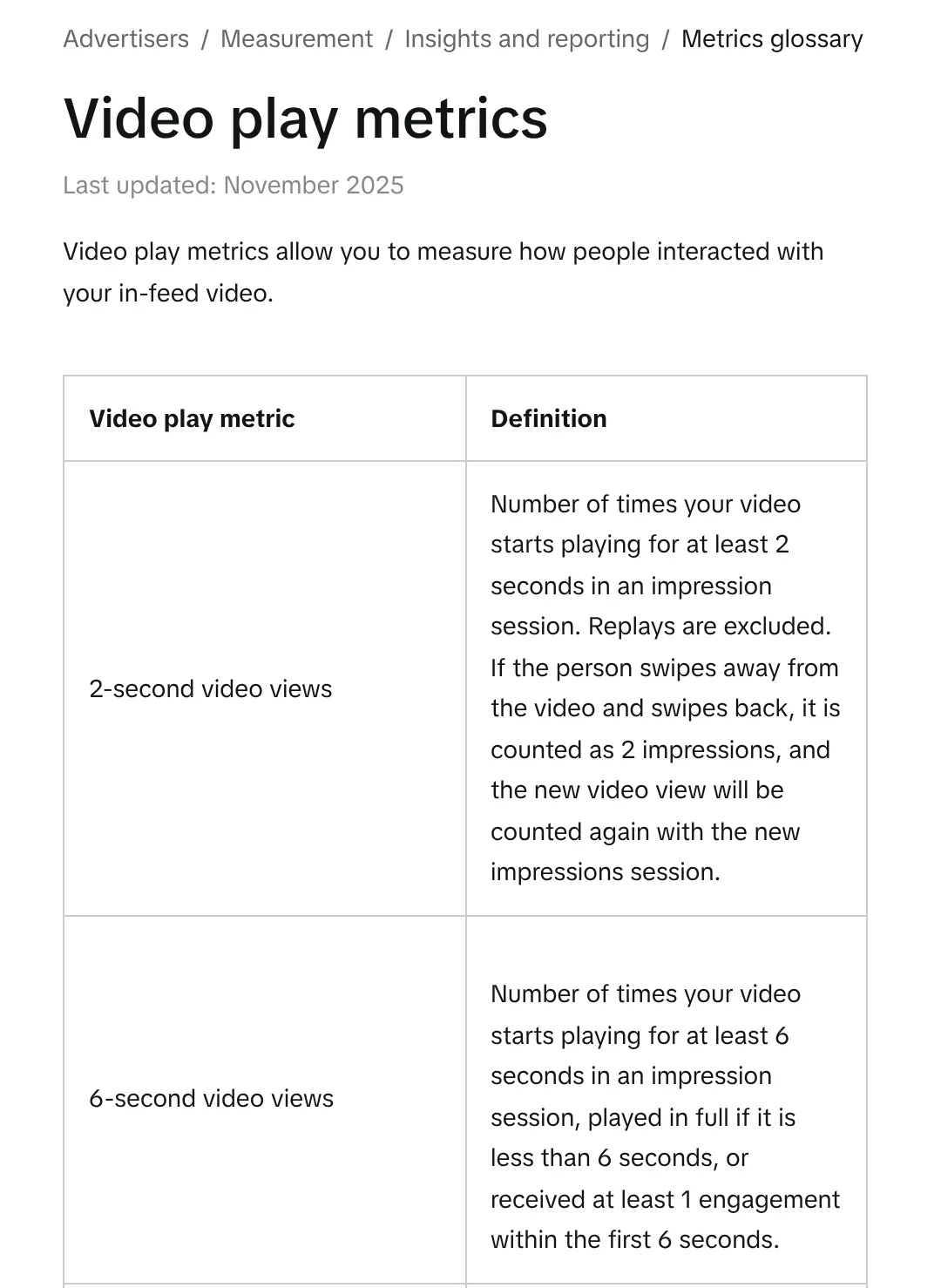
| TikTok | 2-second video views | Times the video plays for at least 2 seconds in an impression session, replays excluded | Whether the hook stops people |
| TikTok | 6-second video views | Plays of at least 6 seconds, full plays of videos shorter than 6 seconds, or at least 1 engagement within the first 6 seconds | Whether the hook holds people |
| TikTok | Average play time per video view | Average play time per single view, including replay time | Whether the body keeps people watching |
| Meta | 3-second video plays | Plays of 3 seconds, or 97% of the length for videos shorter than 3 seconds; replays excluded | The hook on Facebook Reels and Instagram Reels |
| Meta | ThruPlay | At least 6 or 15 seconds watched depending on the goal, or 97% for shorter videos | Retention after the hook |
| YouTube Shorts | TrueView views | 10 seconds watched or the full video if shorter, or a click on the CTA, Like, Comments or Share | The hook and the first 10 seconds |
Definitions come from the help centers of TikTok (November 2025), Meta and Google Ads (accessed November 2026). The Video play metrics page in TikTok Ads Manager’s help center reads as shown below; note the conditions “replays are excluded” and “at least 1 engagement within the first 6 seconds”.
The formulas I use on TikTok:
- Stop rate = 2-second video views / impressions.
- 6-second hold rate = 6-second video views / impressions.
On Meta, swap the numerator for 3-second video plays. Here is a hypothetical example with the three tumbler hooks, each served 10,000 impressions:
| Version | 2-second video views | Stop rate | 6-second video views | 6-second hold rate |
|---|---|---|---|---|
| Hook A (result) | 2,500 | 25% | 1,500 | 15% |
| Hook B (pattern break) | 3,400 | 34% | 1,300 | 13% |
| Hook C (question) | 2,200 | 22% | 1,400 | 14% |
Hook B stops the most people but holds the fewest. Viewers pause out of curiosity, then leave because seconds 3 to 6 follow through too slowly. I would keep B’s opening shot, move the laptop-lift moment earlier and rerun it. Stop and hold rates are only the first layer; the final call still rests on CTR, cost per order and actual orders.
Official documentation does not publish a “benchmark” stop rate by industry. Comparing hooks within the same account, the same ad group and the same time window is the safest way to read them.
When to replace a hook
TikTok recommends refreshing creatives when delivery results show a consistently declining trend, and adding new creatives to the existing ad group rather than creating a new one (TikTok Business Help Center, June 2025). Meta flags creative fatigue when people have seen the same image or video too many times and cost per result rises, and suggests creating a new ad with a materially different image or video (Meta Business Help Center, accessed November 2026). I swap the hook first and keep the body: someone who has seen a hook once will scroll past it the next time.
From a good hook to a video that sells
A hook only buys you a few seconds. The body has to prove the claim, the CTA has to be clear, and the account needs enough variants. A process for producing many variants a month with AI while keeping your brand identity is covered in our post on creative strategy. For TikTok content clipped from a livestream, the first 3 seconds of each clip should be the moment the product proves itself, not the host’s greeting; how to plan the session itself is in our guide to livestream selling.
Something you can do today: watch the first 3 seconds of 5 live videos with the sound off, score them against the checklist above, and fix the hook on any video missing 3 or more points before you raise its budget.
If you want Adtek to script hooks and plan creative tests for TikTok, Reels and Shorts, see our Creative Strategy service or contact Adtek.
Sources
- TikTok Business Help Center (June 2025). Creative best practices for performance ads.
- TikTok Business Help Center (November 2025). Video play metrics.
- TikTok Creative Center (accessed November 2026). Top Ads.
- Meta Business Help Center (accessed November 2026). Best practices for Instagram video ads; Tips to optimize your ad creative for Instagram.
- Meta Business Help Center (accessed November 2026). About text overlays and the safe zone for ads in Stories and Reels; Creative tips for designing product video templates in Commerce Manager.
- Meta Business Help Center (accessed November 2026). 3-second video plays; About ThruPlay; About creative fatigue recommendations in Meta Ads Manager.
- Google Ads Help (accessed November 2026). About the ABCDs of effective video ads.
- Google Ads Help (accessed November 2026). About YouTube ads and view metrics.
Want to apply this to your business?
Send your question or situation. The Adtek team reads every question and gets back to you.
Prefer to chat? Message us on Zalo Categories
 Recent Posts