ENG
 VIE
 +84 9323 494 34


App user acquisition in 2026: a strategy to grow app users at a sensible cost
 November 5, 2026
 Tin Le
A lot of app user acquisition teams brag about a cheap CPI, then find at the end of the quarter that installs went up while the number of transacting users barely moved. Cheap installs are often installs nobody uses, and sometimes they are fake: in Q2 2025, 43% of Android installs for finance apps in Vietnam were fraudulent (AppsFlyer). I work the other way around: pick the event that makes money, set a target CPA from LTV, and only then work out the CPI you can afford.
By the end you can calculate a CPI ceiling for your own app, with two worked examples: an e-wallet app and a health insurance app in Vietnam. Game apps and shopping apps get their own treatment in the articles on mobile game advertising and e-commerce app user acquisition, and the definition of user acquisition (UA) sits in the glossary.
What changed for app user acquisition in 2026
Total app installs in Vietnam reached 2.17 billion in 2024, then slipped 2% in 2025. Android’s share of installs fell from 78% in 2017 to 66% in 2025, while iOS rose from 22% to 33% (AppsFlyer, State of App Marketing Vietnam, November 2025). Installs have plateaued, so every new user costs more, and you need to be sure they actually use the app.
Payment habits, on the other hand, keep growing. In Q1 2026, payments through the Internet channel rose 65.68% in number and 28.85% in value year on year (State Bank of Vietnam, reported by Thoi bao Tai chinh Viet Nam, May 2026). The number of transactions grew more than twice as fast as their value: people pay online more often, in smaller amounts. For an e-wallet app, the money is in how often people use it, not in the install.
That is why, in mobile app marketing today, I don’t set goals in CPI (cost per install). I set goals in cost per the event that actually earns the app money, then work backward to a CPI.
A 5-step framework for any app
- Pick the event that makes money.
- Set a target CPA from LTV, then derive a CPI ceiling.
- Choose ad channels for the app, each with enough budget for the algorithm to learn.
- Build creative that answers what users worry about before they install.
- Measure on iOS and Android, and hand the technical work to your developers.
Think of opening a coffee shop. Before you print flyers, you need to know how much a regular customer spends in a year. Only then do you know how much one flyer is worth.
Step 1: pick the event that makes money
Every type of app has an event after which a user starts to be worth something:
| App type | Event that makes money | Proxy event (when the main event is too rare) |
|---|---|---|
| E-wallet, digital bank | First transaction | Successful eKYC (electronic identity check), linked bank account |
| Health insurance | First policy purchase | Quote requested, phone number submitted |
| E-commerce | First order | Add to cart, checkout started |
| Game | In-app purchase or day-7 ad revenue | Level completed, day-1 return |
The rule: choose the deepest event that still happens often enough every day. Google recommends picking an in-app action completed by at least 10 different users per day in the campaign (Google Ads Help, Best practices for App campaigns). If you are under 10, optimize for the proxy event first.
Step 2: set a target CPA from LTV, then derive CPI
- LTV (lifetime value): the gross profit one user brings in over a set period, for example 12 months.
- CPA (cost per action): the ad cost for one user completing the event from step 1.
The formulas I use:
Target CPA = (LTV – new-user incentive) × (1 – profit share you want to keep)
CPI ceiling = target CPA × install-to-event rate (if 20 out of 100 installers make a transaction, the rate is 20%)
The definition of CPI and reference levels are in the article what is CPI. Here CPI is only the number you arrive at last. Run the numbers separately for iOS and Android, because LTV differs between the two.
Hypothetical example 1: an e-wallet app
Say I am running ads for a new e-wallet app. Every number below is an assumption:
| Line | How to calculate | Assumption |
|---|---|---|
| A. 12-month gross profit of a user who has transacted | Cohort data (users who installed in the same month) | 120,000 VND |
| B. New-user reward (cashback on first transaction) | App policy | 30,000 VND |
| C. Profit share you want to keep | Your call | 30% |
| D. Maximum CPA per first transaction | (A – B) × (1 – C) | 63,000 VND |
| E. Install to successful eKYC rate | MMP data | 40% |
| F. eKYC to first transaction rate | Internal data | 50% |
| G. Maximum CPA per eKYC | D × F | 31,500 VND |
| H. CPI ceiling | D × E × F | 12,600 VND |
A channel reporting a CPI of 15,000 VND is not necessarily losing money. If that channel’s eKYC rate is 55%, its CPA per eKYC is 15,000 / 55% = 27,300 VND, still under the 31,500 VND ceiling.
Now suppose the campaign gets only 6 first transactions a day but 15 eKYCs. Under the 10-users-per-day threshold, I optimize for eKYC with a target CPA of 31,500 VND. Google recommends a daily budget of at least 10 times the target CPA, so 315,000 VND or more per day.
Finance apps also need a fraud discount. In Q2 2025, the install fraud rate for finance apps in Vietnam was 43% on Android and 27% on iOS, more than double the market average (AppsFlyer, November 2025). That is why I pay for eKYC, not for installs: an emulator can’t pass the face scan. The funnel and regulations specific to this category are covered in the article on bank and fintech marketing.
Hypothetical example 2: a health insurance app
In the first half of 2026, non-life insurance premiums, the group that includes health insurance, grew more than 13.49% year on year, while life insurance fell 4.5% (Ministry of Finance, reported by Tap chi Kinh te Tai chinh, July 2026). An insurance app differs from an e-wallet: users buy rarely, each purchase is large, and they often want an advisor to call them back.
| Line | How to calculate | Assumption |
|---|---|---|
| A. Average annual premium per policy | Sales data | 3,000,000 VND |
| B. Share the company keeps after costs and expected claims | From finance | 20%, or 600,000 VND |
| C. Year-2 renewal rate | Renewal data | 60% |
| D. 2-year LTV | B + B × C | 960,000 VND |
| E. Profit share you want to keep | Your call | 40% |
| F. Maximum CPA per policy | D × (1 – E) | 576,000 VND |
| G. Quote to purchase rate | CRM data | 8% |
| H. Maximum CPA per quote | F × G | 46,080 VND |
| I. Install to quote rate | MMP data | 25% |
| J. CPI ceiling | H × I | 11,520 VND |
I keep a 40% margin here, higher than in the e-wallet example, because renewal is an estimate and claims can run over plan. With only a few policies a day, I optimize for “quote requested”. When a policy closes through an advisor, send a “policy purchased” event from the CRM to the MMP so the channel still gets credit.
Don’t:
- Apply the LTV of a five-year renewing customer to every install. Your CPA ceiling will be several times too high.
- Calculate LTV on premium revenue. A 3,000,000 VND annual premium is not money the company keeps.
- Count organic installs in the denominator when calculating a paid channel’s rates.
Step 3: choose ad channels for your app
| Channel | Where ads appear | Optimizes for | Worth knowing |
|---|---|---|---|
| Google App campaigns | Google Search, Google Play, YouTube, Discover, Display Network | Installs (target CPI), in-app actions (target CPA), value (target ROAS) | Daily budget of at least 50 times target CPI, or 10 times target CPA (Google Ads Help) |
| Meta Advantage+ app campaigns | Facebook, Instagram, Messenger, Audience Network | Installs, app events, value | Targeting limited to country, language and operating system; no interests or lookalikes (Meta Business Help Center) |
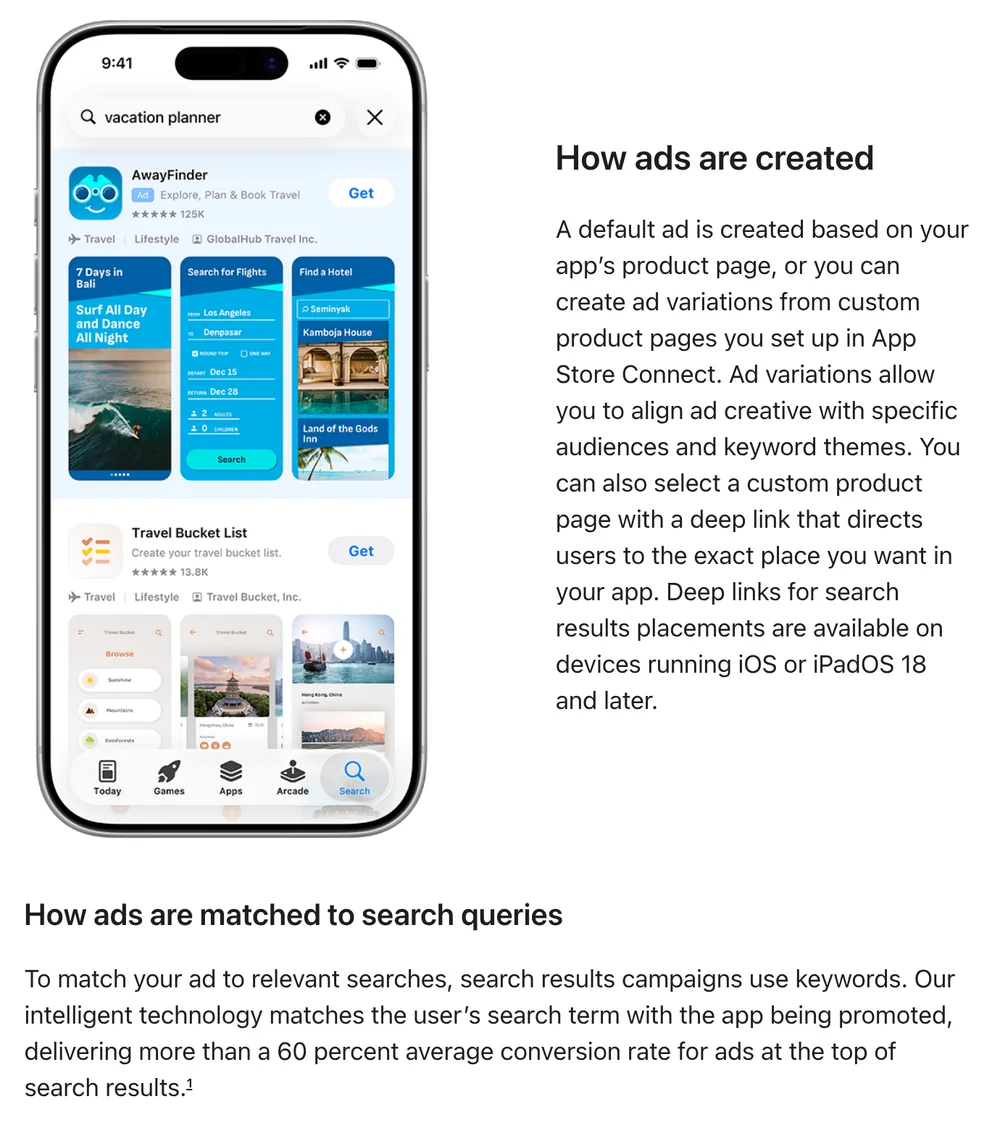
| Apple Ads | App Store search results | Keywords users type | Ads at the top of search results average a conversion rate above 60% (Apple Ads, data from November 2024 to October 2025) |
| TikTok Ads | Short-video feed | Installs, in-app events | Suits apps that need a video to show how they work |
| Other in-app ad networks | Inside games and utility apps | Installs, ROAS | Suits games; turn on your MMP’s fraud protection first |
Apple Ads (formerly Apple Search Ads) only shows an ad when the app is relevant to the keyword. Someone searching “ví điện tử” (e-wallet) on the App Store already has the need, so this is usually the first channel I turn on for iOS.
Early on I run few channels and give each enough money. If the budget is 1 million VND a day and one Google campaign optimizing for eKYC already needs 315,000 VND, run Google, Meta and Apple Ads only.
Paid ads are not the only source. A weak store page makes every channel more expensive, so do ASO (app store optimization) first. If your website gets a lot of traffic, add web-to-app flows with deep links: according to Google, advertisers who use deep linking see conversion rates more than 2 times higher on average. How Meta handles delivery when you target broadly is covered in the pillar article on Meta Andromeda.
Step 4: creative for app ads
Once targeting is handed to the algorithm, creative decides who sees the ad. Google allows up to 10 text, 20 image and 20 video assets per ad group; videos should run 10 to 30 seconds and come in portrait, landscape and square. Meta lets you upload up to 50 images, videos or playables at once.
Before installing a finance or insurance app, people ask themselves: (1) Is this app safe? (2) How long until I can use it? (3) What do I get the first time? (4) Are there hidden fees?
The formula for each video: [One worry] + [Visible proof] + [First thing to do in the app].
For an e-wallet app: “How long does it take to open a wallet?” + a screen recording of photographing the ID card and scanning the face in one continuous shot + “Link your bank, get cashback on your first transaction”. This video answers worries (2) and (3).
For a health insurance app: “Does insurance really pay out?” + the benefits table and the in-app claim button on screen + “Get a quote right in the app”. This video answers worries (1) and (4).
Don’t:
- Make 20 videos that differ only in background color. The algorithm treats them as nearly one ad.
- Promise “100% approval” or “the highest returns”. Finance ads get rejected easily, and users drop out at eKYC.
- Judge creative by CPI. A video with cheap installs but few eKYCs is a bad video.
Step 5: measurement on iOS and Android
The MMP: one shared ledger
An MMP (mobile measurement partner) such as AppsFlyer or Adjust is the accountant who pulls every branch’s receipts into one ledger. Each ad platform claims installs for itself, so their totals always exceed the real number. The MMP credits each install to one channel and filters out install fraud.
iOS: a secret ballot
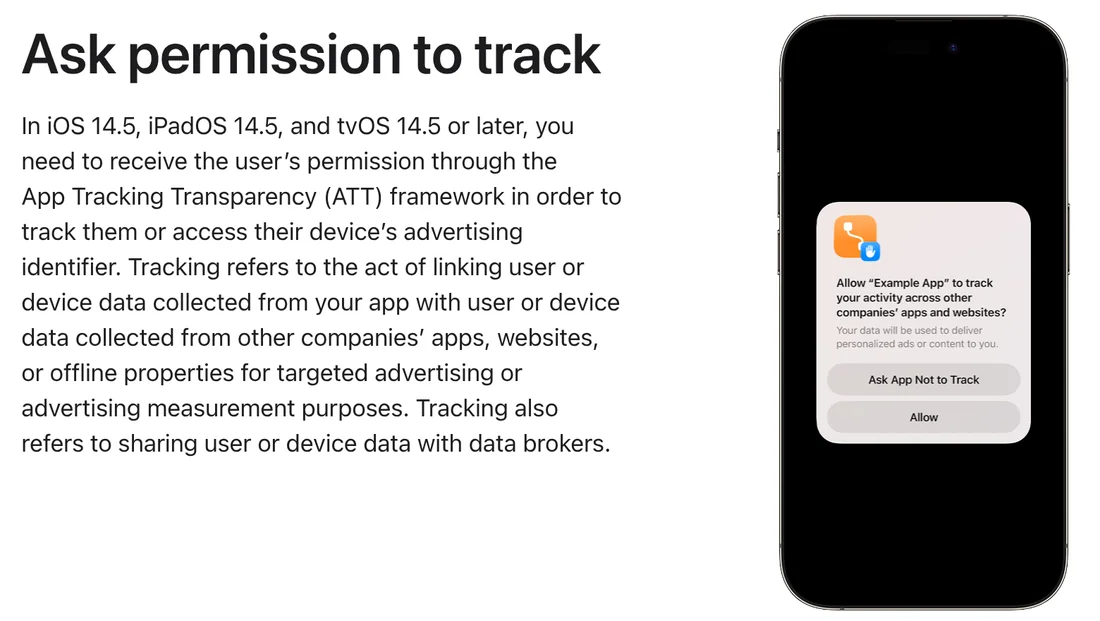
On iPhone, an app must ask permission through ATT (App Tracking Transparency) before tracking; how to ask within Apple’s rules is in the article on ATT on iOS. Users who decline can still be measured through AdAttributionKit and the older SKAdNetwork framework. It works like a secret ballot: you know how many votes each campaign got, not who voted.
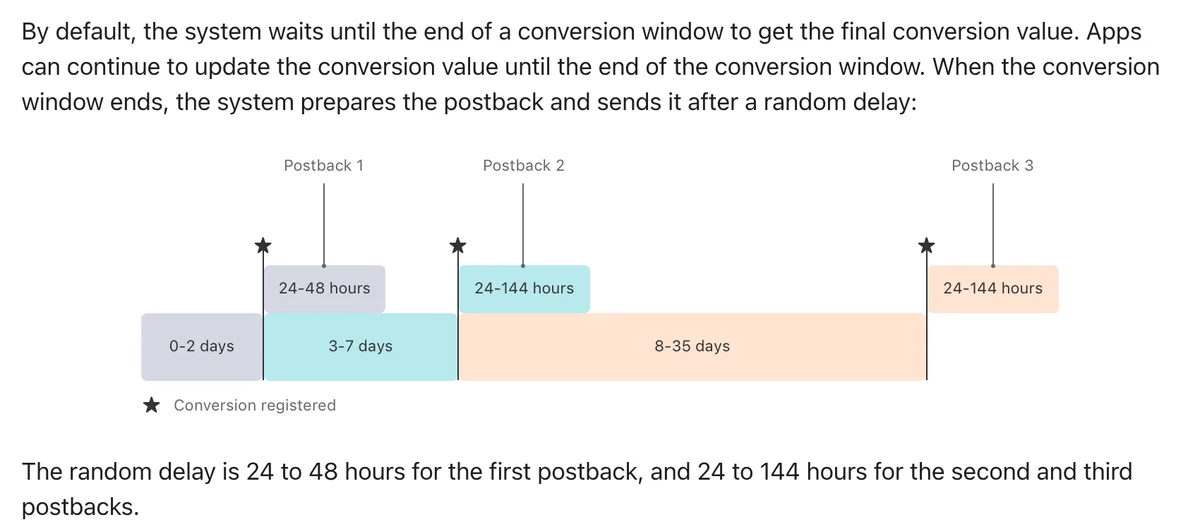
Apple sends up to 3 reports (postbacks) per install, covering what the user did on days 0 to 2, days 3 to 7 and days 8 to 35. The first report arrives 24 to 48 hours later, the next two 24 to 144 hours later (Apple Developer). For an e-wallet, the event in the first 2 days should be eKYC; for insurance, a quote. How to read the gap between platform numbers and your MMP is in the article on iOS app ad measurement.
Android: Google Play’s referral slip
Android has an advertising ID. Users can delete it, after which the app only reads a string of zeros (Google Play Console Help). To make up for that, Google Play offers the Install Referrer: when someone installs the app, Play passes along the referrer URL, the time of the ad click and the time the install began (Android Developers). Picture a customer walking into a shop with a referral slip: the MMP uses that slip to credit the channel and catch suspicious installs.
Tasks for your developers
| Task | Details | Why |
|---|---|---|
| 1. Install the MMP SDK | Latest version, supporting AdAttributionKit and SKAdNetwork (iOS) and Install Referrer (Android) | One ledger for every channel |
| 2. Name the events | Registration, eKYC, first transaction, quote requested, policy purchased; include revenue where available | Every platform optimizes for the same event |
| 3. iOS conversion value schema | The most important event in the first 2 days gets the highest value | The first report is the most detailed |
| 4. Send events from the server and CRM | Policies closed through advisors, transactions confirmed in the core system | Events outside the app still reach the right channel |
| 5. Deep links | Links that open the offer screen directly, even if the app is not installed yet | Users coming from an ad don’t have to search again |
| 6. Fraud protection | Block emulators and installs with abnormal click-to-install times | Don’t pay for fake installs |
One-page app user acquisition strategy sheet
I fill in this sheet before launching the first campaign. Copy it into Google Sheets and complete the “Yours” column.
| Item | Question | E-wallet example (hypothetical) | Yours |
|---|---|---|---|
| Event that makes money | After which step does a user become valuable? | First transaction | |
| Optimization event | Deepest event with at least 10 users a day? | eKYC | |
| LTV | Gross profit over how many months? | 120,000 VND, 12 months | |
| Target CPA | (LTV – incentive) × (1 – share kept) | 63,000 VND | |
| CPA for the optimization event | Target CPA × rate to the main event | 31,500 VND | |
| CPI ceiling | Target CPA × install-to-main-event rate | 12,600 VND | |
| Channels | Does each channel have its minimum budget? | Google, Meta, Apple Ads | |
| Measurement | Have developers finished the 6 tasks above? | Task 4 pending | |
| Payback period | How many months until profit covers the cost? | About 9 months |
Payback in the example: 120,000 VND of profit a year is 10,000 VND a month. A CPA of 63,000 VND plus a 30,000 VND reward is 93,000 VND; divided by 10,000, that is about 9 months. If that is longer than the company’s cash flow can carry, lower the target CPA. Cross-check against MER and CAC for the whole business using the article on growth marketing metrics, so you don’t end up with every channel profitable on paper and the total losing money.
Checklist before scaling your app ad budget
- The optimization event is the same on every platform and in the MMP; the fraud rate is not rising.
- Each channel’s CPA for the optimization event has stayed under the ceiling for at least 3 weeks in a row.
- Day-7 retention rate of users from ads is not much lower than that of users who installed on their own.
- Organic installs don’t drop when ads are on. If they do, ads are eating into users you would have gotten for free.
- Each user worry has at least 2 videos running.
- Raise the budget by about 20% at a time, wait a few days, then raise again.
If you want to grow app downloads while keeping CPA under the ceiling, Adtek’s App User Acquisition team can build this plan with you and run Google, Meta and Apple Ads; reach us through the Adtek contact page.
Sources
- AppsFlyer: State of App Marketing Vietnam (November 2025).
- State Bank of Vietnam, reported by Thoi bao Tai chinh Viet Nam: Cashless payments keep accelerating (May 5, 2026).
- Ministry of Finance, reported by Tap chi Kinh te Tai chinh: Insurance market premiums in the first half of 2026 (July 18, 2026).
- Google Ads Help: About App campaigns; Best practices for App campaigns (accessed October 30, 2026).
- Meta Business Help Center: About Advantage+ app campaigns (accessed October 30, 2026).
- Apple Ads: Search results. Apple Developer: AdAttributionKit; conversion windows.
- Google Play Console Help: Advertising ID. Android Developers: Play Install Referrer.
Want to apply this to your business?
Send your question or situation. The Adtek team reads every question and gets back to you.
Prefer to chat? Message us on Zalo Categories
 Recent Posts