ENG
 VIE
 +84 9323 494 34


B2B SEO: how expert E-E-A-T content generates leads
 November 6, 2026
 Tin Le
B2B SEO doesn’t need lots of traffic. It needs the right person in a purchasing department to find your website and fill in your form.
To get there, every page has to answer a question business buyers ask before they request a quote, backed by the kind of evidence Google calls E-E-A-T. Then you connect your forms to GA4 and your CRM, so at the end of the quarter you can count qualified leads and contracts, not just visits.
How B2B SEO differs from retail SEO
When you buy a bunch of vegetables at the market, you decide in a minute. A factory choosing a carton box supplier for the whole year works differently: a purchasing officer searches, the warehouse manager weighs in, finance asks about price, and the director signs off. Each of them searches in a different way and reads a different page.
| Difference | Retail (B2C) | Selling to businesses (B2B) |
|---|---|---|
| Searches per keyword | Thousands to tens of thousands | Dozens to a few hundred |
| Who decides, and how long it takes | One person, minutes to days | Several people, weeks to months |
| What you count | Orders | Forms, calls, qualified leads, contracts |
| What the buyer needs to see | Photos, price, reviews | Specifications, process, certifications, the person accountable |
According to Google Keyword Planner (Vietnam, October 2026), “thùng carton” (carton box) gets 12,100 searches a month, a figure that includes people buying a few boxes to move house. “Công ty sản xuất thùng carton” (carton box manufacturer) gets only 110, and “thùng carton xuất khẩu” (export carton boxes) 40. Business buyers sit inside those small clusters.
Even the Vietnamese query “SEO B2B” gets only 20 searches a month, and “marketing B2B” 170. So don’t judge B2B SEO by organic traffic. Judge it by qualified leads and signed contracts.
What E-E-A-T is and how Google uses it
E-E-A-T stands for Experience, Expertise, Authoritativeness and Trust. The concept comes from Google’s Search Quality Rater Guidelines. The current edition is dated September 11, 2025 and runs to 182 pages (Google).
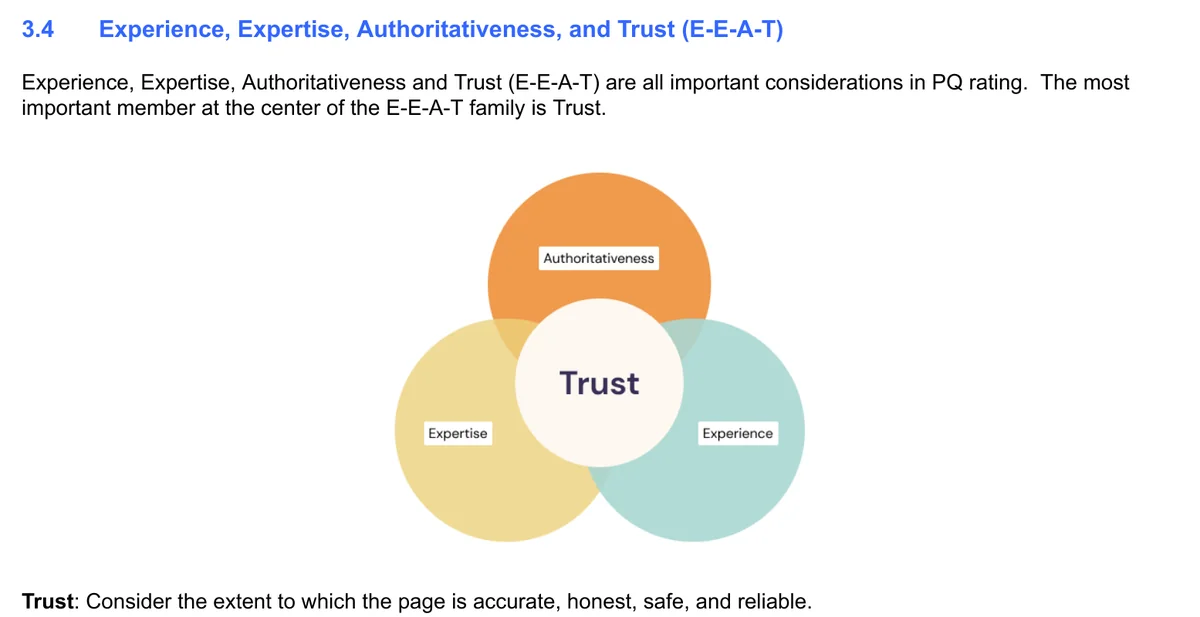
Three points anyone doing B2B SEO should remember:
- Trust matters most. An untrustworthy page has low E-E-A-T no matter how experienced or expert its author seems (Search Quality Rater Guidelines, section 3.4).
- E-E-A-T is not a specific ranking factor. Google uses a mix of signals to identify content with good E-E-A-T. Quality raters don’t control how pages rank (Google Search Central, updated October 5, 2026).
- Money and health topics get closer scrutiny. Google calls them YMYL (Your Money or Your Life: topics that can affect people’s health, financial stability or safety) and gives even more weight to strong E-E-A-T there. B2B sites in finance, insurance or medical equipment can easily fall into this group.
In everyday terms, E-E-A-T is your website’s capability profile. A purchasing department always asks suppliers for a company profile, certificates and a list of past clients. Google’s raters ask the same questions, only on a website.
E-E-A-T evidence on a B2B website
Raters are told to look in three places: what the website says about itself, what others say about it, and what is visible on the page itself (section 3.4). Applied to B2B:
| Component | What Google asks | Evidence on a B2B website |
|---|---|---|
| Experience | Has the author done or used this first-hand? | Real factory photos, the real process, your own test measurements with test dates |
| Expertise | Does the author have the knowledge the topic needs? | An engineer or department head writes or reviews the page, with name, title and years in the trade |
| Authoritativeness | Is the site known as a go-to source? | Trade press, industry associations and partners mention you; other sites link to you with a backlink |
| Trust | Is the page accurate, honest and safe? | Company name, tax ID, address, warranty policy, how form data is protected |
Google also flags conflicts of interest: a manufacturer “reviewing” its own product is less trustworthy than a real user sharing their experience. A website full of self-praise is a website short on Trust.
B2B SEO strategy: pick topics the way buyers buy
A hypothetical example: I’m doing SEO for a carton box factory that sells to manufacturers in the industrial parks of southern Vietnam. I work in three steps.
Step 1: List the questions each person on the buying team asks
I sit down with the sales team for a session and write down the questions customers ask before they get a quote:
- Can we order a trial run of 500 boxes? What’s the minimum order quantity? (purchasing officer)
- How many kilograms can a 5-ply box hold, and how high can we stack them in the warehouse? (warehouse manager)
- How many days does delivery take to the industrial parks around Ho Chi Minh City? (purchasing)
- What certifications do export goods need, and does the factory have them? (quality manager)
- What drives the price, and why does every supplier quote differently? (finance)
- What happens if boxes are defective or delivery is late? (factory director)
Step 2: Match each question to a page
| Question | Page type | Target keyword in Vietnam (searches/month) |
|---|---|---|
| (1) | Service page “Custom carton box manufacturing” with a minimum order section | “công ty sản xuất thùng carton”, carton box manufacturer (110); “xưởng sản xuất thùng carton”, carton box factory (110) |
| (2) | Article comparing 3-ply and 5-ply boxes, with a specification table | “thùng carton 5 lớp”, 5-ply carton box (480); “thùng carton 3 lớp”, 3-ply carton box (320) |
| (3) | Delivery area page, with one section for each area customers name | “thùng carton bình dương”, carton boxes Binh Duong (70) |
| (4) | Certifications and export page | “thùng carton xuất khẩu”, export carton boxes (40) |
| (5) | Article “How carton box prices are calculated”, with a table of what moves the price | “giá thùng carton”, carton box price (140) |
| (6) | Warranty and replacement policy page | No keyword needed; this page exists for Trust |
This is a topic cluster: one pillar page on carton box manufacturing, with supporting pages that each answer one question and link to one another. Question (6) has no search volume, but the purchasing department will ask it before signing.
Step 3: Check keywords against data
Do your keyword research with two free tools: Keyword Planner for search volume, and Google Search Console for the queries your site already appears for. The Performance report shows clicks, impressions, CTR and position for each query and each page (Search Console Help).
In B2B, I keep keywords with as few as 30 to 100 searches a month, because one contract with a factory is worth many retail orders combined. Only drop a keyword when the search intent is wrong.
Writing expert content for B2B SEO
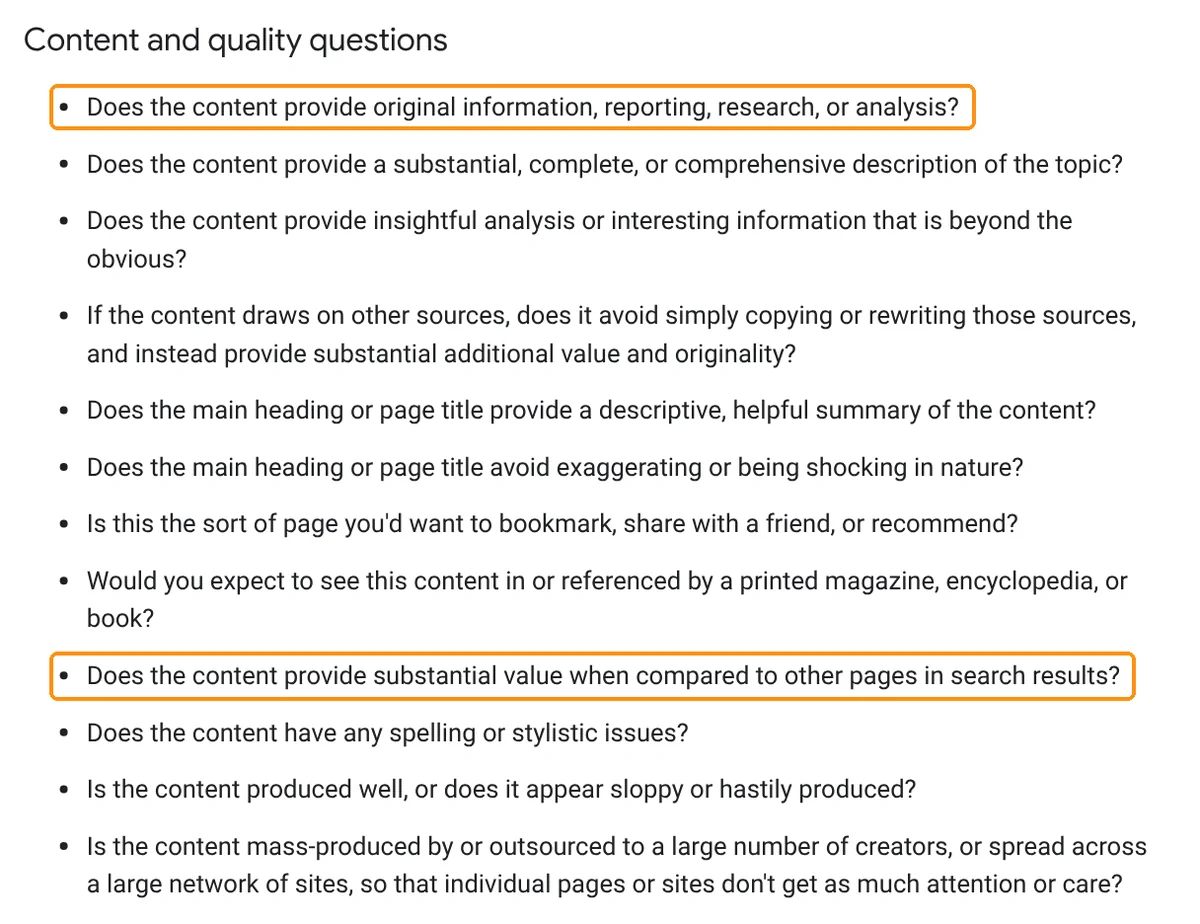
Google’s helpful content guidance includes a list of self-assessment questions. Two fit B2B best: does the content provide original information or analysis, and does it provide substantial value compared with other pages in the search results (Google Search Central)? Google also answers a common myth on the same page: it has no preferred word count.
The formula I use for every page:
[Answer the question directly] + [Evidence you produced or measured yourself] + [When it’s not the right fit] + [Who wrote it, who reviewed it] + [Next step]
Filled in for question (2) from the example above; all numbers are hypothetical:
- Direct answer: the factory’s 5-ply box at 60x40x40 cm withstands 450 kg of compression and stacks 5 high in a dry warehouse.
- Evidence: photos of the compression tester at the factory, a table of results from the last 3 batches, test dates and who ran the test.
- When it’s not the right fit: cold storage and high humidity reduce a box’s load strength, so a different paper grade is needed; for goods under 5 kg, a 3-ply box is enough and cheaper.
- Who wrote it, who reviewed it: written by the head of the technical department, with name, title, 12 years in packaging, and a link to the author page.
- Next step: a form that says “Send your product dimensions and weight, get a box recommendation within 24 hours”. Every page is a landing page, so the action has to match the page’s question, not a generic “Contact us” button.
The “not the right fit” line is the one most often skipped, yet it builds Trust faster than anything else: the seller is willing to say when you shouldn’t buy from them.
What not to do with B2B content
- Opening with “In the era of Industry 4.0, packaging is becoming ever more important…” That sentence is true of every factory, so it says nothing about yours.
- Writing “top quality, competitive prices, fast delivery” with no test results, price points or delivery times.
- Inventing author names, using AI-generated headshots or claiming credentials that don’t exist. Google calls this deception, and it makes a page untrustworthy to both readers and Google’s systems.
- Having AI write 50 articles a week that nobody reviews, or stitching together content from competitors’ sites. Google classifies this as scaled content abuse in its spam policies, and raters give it the Lowest rating under section 4.6.5 of the guidelines.
- Changing the “updated” date when the content hasn’t changed. Google lists this as a sign of content made for search engines.
Using AI is not banned: under section 4.6.6, the use of AI alone doesn’t determine quality; what gets rated is the effort and the value added. How to use AI for the right tasks is covered in our article on using AI to improve SEO.
Author, About and contact pages
Google encourages a byline on every article that leads to a page about the author. The guidelines also require that it be clear who is responsible for the website and who created the content (section 2.5.2). For B2B, you need three things:
- Author page: real name, title, area of responsibility, articles written.
- About page: legal name, tax ID, year founded, where the factory is, and certifications with their numbers so customers can check them.
- Case studies and white papers: name a client in a case study only with their consent; a white paper should contain data you measured yourself, with your method.
Schema markup (structured data) such as Organization and Article must match the visible text on the page (Google).
Tracking leads from SEO: forms, GA4 and CRM
Lead generation from SEO only means something when you can answer this: how many qualified leads and how many contracts did Organic Search bring in this month? A showroom that counts people walking in hasn’t done enough; it needs to know who signed and which door they came through.
Step 1: Make the contact form record the source
A contact form only needs name, company, work email, phone number and request. Add hidden fields that record the page the form was sent from and the traffic source, so every lead arrives in your CRM already tagged “from Google, 5-ply vs 3-ply comparison page”. The form must also ask for consent to process personal data; for Vietnam, see our guide to the Personal Data Protection Law.
Step 2: Send a generate_lead event to GA4
Google recommends the generate_lead event when a user submits a form or a request for information (Google Analytics Help). Mark it as a key event: Admin, Data display, Events, then click the star. A standard property can mark up to 30 key events. Standard reports can take up to 24 hours to show the data, and marking an event doesn’t change historical data (Google Analytics Help).
Step 3: Have the CRM send lead status back to GA4
Whether a lead is qualified and whether it signs is recorded by the sales team in the CRM. Google Analytics 4 has a ready-made set of events for this, which Google says are useful for business-to-business sales: qualify_lead, disqualify_lead, working_lead (in conversation with a rep), close_convert_lead (became a customer) and close_unconvert_lead (did not convert) (Google Analytics Help).
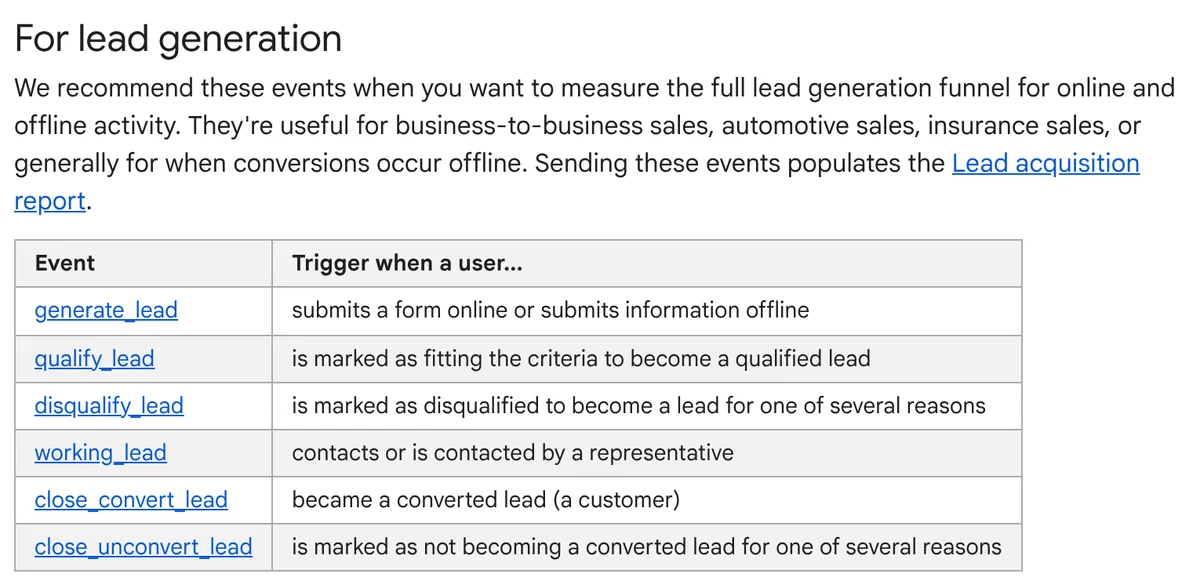
Once these events are flowing, the Lead acquisition report in GA4 shows New leads, Qualified leads and Converted leads by channel, including Organic Search (Google Analytics Help).
For the setup, send this table to your technical team:
| Task for the technical team | Expected result |
|---|---|
| Add hidden fields to every form: source page, traffic source, UTM parameters, GA4 client ID | Every lead in the CRM has a source and a landing page |
| Fire generate_lead when a form submits successfully (not on errors) and mark it as a key event | generate_lead counts in GA4 roughly match form counts in the CRM |
| When sales changes a lead’s status in the CRM, send qualify_lead and close_convert_lead to GA4 through the Measurement Protocol (Google’s route for sending server-side and offline interactions) | The Lead acquisition report shows Qualified leads and Converted leads |
| Filter out junk and duplicate leads before sending qualify_lead | Fake leads never count as qualified leads |
The Measurement Protocol only supplements the GA4 tag on your website, and Google recommends that new server-to-server integrations go through the Data Manager API (Google Analytics). Either route works, as long as lead status makes it back to GA4.
Step 4: Calculate qualified leads and cost
A hypothetical example: in November, the carton factory’s Organic Search channel records 40 generate_lead events, 14 qualify_lead and 3 close_convert_lead. SEO costs for that month (writer, engineer review, tools) come to VND 60 million.
- Qualified lead rate = 14 / 40 = 35%.
- Close rate = 3 / 14 = 21.4%.
- Cost per qualified lead = 60,000,000 / 14 = VND 4.29 million.
- Cost per new customer = 60,000,000 / 3 = VND 20 million.
The last figure is the CAC (customer acquisition cost) of your SEO channel; how to read CAC against LTV is explained in our guide to growth marketing metrics. Compare it with the CAC of search ads (for example a Google AI Max for Search campaign) and you know where to put your money. B2B leads often take months to sign, so I review these numbers quarterly.
Do AI Overviews make B2B SEO pointless?
Google says there are no additional requirements to appear in AI Overviews or AI Mode: a page only needs to be indexed and eligible to be shown with a snippet. Impressions and clicks from AI Overviews are counted in the Search Console Performance report under the Web search type (Google, updated December 10, 2025).
How to optimize content so AI tools cite it is covered in our pillar guide what AIO is. For industries with long buying cycles, how to connect SEO, LinkedIn and CRM is covered in our digital marketing strategy for industrial real estate.
B2B SEO checklist
This isn’t an on-page SEO checklist or a technical SEO audit; it covers content and lead tracking. Technical basics such as page speed and sitemaps are already covered in Google’s SEO Starter Guide. Copy it into Google Sheets and tick it off once a month.
| # | What to check | Group |
|---|---|---|
| 1 | Questions from each person on the buying team are listed | Strategy |
| 2 | Each question has a page that answers it, with the right search intent | Strategy |
| 3 | There is a pillar page, and supporting pages link to each other | Strategy |
| 4 | The answer sits in the first paragraph of every page | Content |
| 5 | Pages show your own measurements, photos and processes, with dates | Experience |
| 6 | Every page has a “when it’s not the right fit” section | Trust |
| 7 | Bylines lead to real author pages; technical articles name a reviewer | Expertise |
| 8 | The About page shows legal name, tax ID, address and certification numbers | Trust |
| 9 | Warranty and data privacy policies are published | Trust |
| 10 | No invented authors and no AI-generated headshots | Trust |
| 11 | Every AI-assisted article is edited and approved by a practitioner | Content |
| 12 | Every page ends with one specific action and a short form | Conversion |
| 13 | Forms have hidden fields for source and landing page, plus a consent line | Measurement |
| 14 | generate_lead is a key event; the CRM sends qualify_lead and close_convert_lead to GA4 | Measurement |
| 15 | Quarterly report: qualified leads, new customers and CAC for Organic Search | Measurement |
Items 5, 6 and 13 are the three B2B websites most often miss. Finish those before you write another new article.
If you need a B2B SEO strategy and want your forms, GA4 and CRM connected so you can count qualified leads, see how Adtek works on our SEO services page or contact Adtek.
Sources
- Google, Search Quality Rater Guidelines, September 11, 2025 edition: General Guidelines (PDF).
- Google Search Central: Creating helpful content (October 5, 2026); Spam policies (August 28, 2026); AI features and your website (December 10, 2025); SEO Starter Guide.
- Search Console Help: Performance report (accessed October 30, 2026).
- Google Analytics Help, accessed October 30, 2026: Recommended events; Key events; Lead acquisition report; Measurement Protocol (June 8, 2026).
- Google Ads Keyword Planner, Vietnam, Vietnamese language, checked October 30, 2026.
Want to apply this to your business?
Send your question or situation. The Adtek team reads every question and gets back to you.
Prefer to chat? Message us on Zalo Categories
 Recent Posts