ENG
 VIE
 +84 9323 494 34


Real estate lead generation in Vietnam 2026: from ads to CRM
 November 10, 2026
 Tin Le
Contents
It’s Monday morning, and you report last month’s real estate lead generation numbers: 3,000 leads at 200,000 VND each. The head of sales pushes back right away: the team called all 3,000 numbers, and only 72 people came to the show unit all month (hypothetical figures, worked through in the first section). Both of you have the numbers right. What’s missing is the link from a lead to a site visit and a deposit.
By the end you’ll have a screening form, a way to connect your ads to the CRM, and a worksheet that works backward from the number of units you need to sell. Industrial real estate, where the buyer is a foreign direct investor, has its own article on digital marketing for industrial real estate.
What real estate lead generation should measure
Nobody buys an apartment worth several billion dong through a form. Buyers leave a number, take a call, visit the project and weigh it for weeks. I measure four stages:
- Lead: someone who leaves details through a form, a message or a call.
- Qualified lead (QL): a valid number, a real need, within the price band and unit types the project is selling. Sales marks it in the CRM after the first call.
- Site visit: the buyer comes to the show unit or sales gallery.
- Transaction: a deposit or a signed sale and purchase contract.
Cost per qualified lead (CPQL) = ad spend / number of QLs. Cost per site visit works the same way. Spend 500 million VND, get 400 QLs and 100 site visits, and CPQL is 1.25 million while each site visit costs 5 million VND. I covered the QL and CPQL framework in detail in the international school enrollment marketing guide; housing adds a site visit stage because that is where sales closes.
Example: cheap leads, nobody shows up
Example (hypothetical): an apartment project spends 600 million VND in its first month of sales. Option A: a form that asks only for name and phone number. Option B: a form with screening questions and phone verification.
| Metric (hypothetical) | A: short form | B: screening form |
|---|---|---|
| Leads | 3,000 | 1,200 |
| Cost per lead (CPL) | 200,000 VND | 500,000 VND |
| Lead to QL rate | 12% | 40% |
| QLs | 360 | 480 |
| QL to site visit rate | 20% | 25% |
| Site visits | 72 | 120 |
| Cost per site visit | 8.3 million VND | 5 million VND |
On CPL, option A is 2.5 times cheaper. On site visits, option B delivers 48 more for the same money, and sales only has to call 1,200 numbers.
Real estate ad policies on Meta, Google and Zalo
Many marketers hear that “Meta restricts targeting for housing ads” and assume it applies in Vietnam. The platforms’ own documentation says otherwise.
Meta: the Housing Special Ad Category
Meta defines a housing ad as one that promotes or links to a housing opportunity: sale or rental listings, real estate services, mortgage loans. You must choose a Special Ad Category if you are an advertiser in the United States, or if your audience is in the US, Canada or certain European countries (Meta, About ads for housing). Vietnam is not on that list, so a developer advertising to buyers inside Vietnam does not have to choose it.
If you sell to overseas Vietnamese in the US, Canada, Germany or France, the rules kick in: age fixed at 18 to 65+, all genders, no postal code targeting, city targeting expanded to a wider radius (15 miles, about 24 km, in Meta’s US example), and no Advantage+ lookalike (Meta, About audiences for housing, employment or financial products and services campaigns). Run the overseas campaign separately and pick the category from the start.
Google: restrictions apply only in the US and Canada
Housing ads targeting the US and Canada cannot use gender, age, marital status, parental status or ZIP codes; radius targeting needs at least 1 km (Google Ads Help, Personalized advertising). Real estate ads aimed at searchers in Vietnam are not subject to these limits.
Zalo: specific conditions for Form ads
Zalo is Vietnam’s largest messaging app, and its ad platform Zalo Ads has a real estate section in its Form ad rules (updated September 18, 2026). Eligible property types: apartments, villas, townhouses and land plots. Conditions:
- The developer is a legal entity; the ad names the project, one project per ad.
- The project is publicly on sale at a clear location.
- A project not yet on sale must display “Dự án chưa được mở bán công khai” (project not yet publicly on sale) on the ad image, form image and form description; price, unit count and launch date must be marked as expected; the ad must not suggest deposits are being taken.
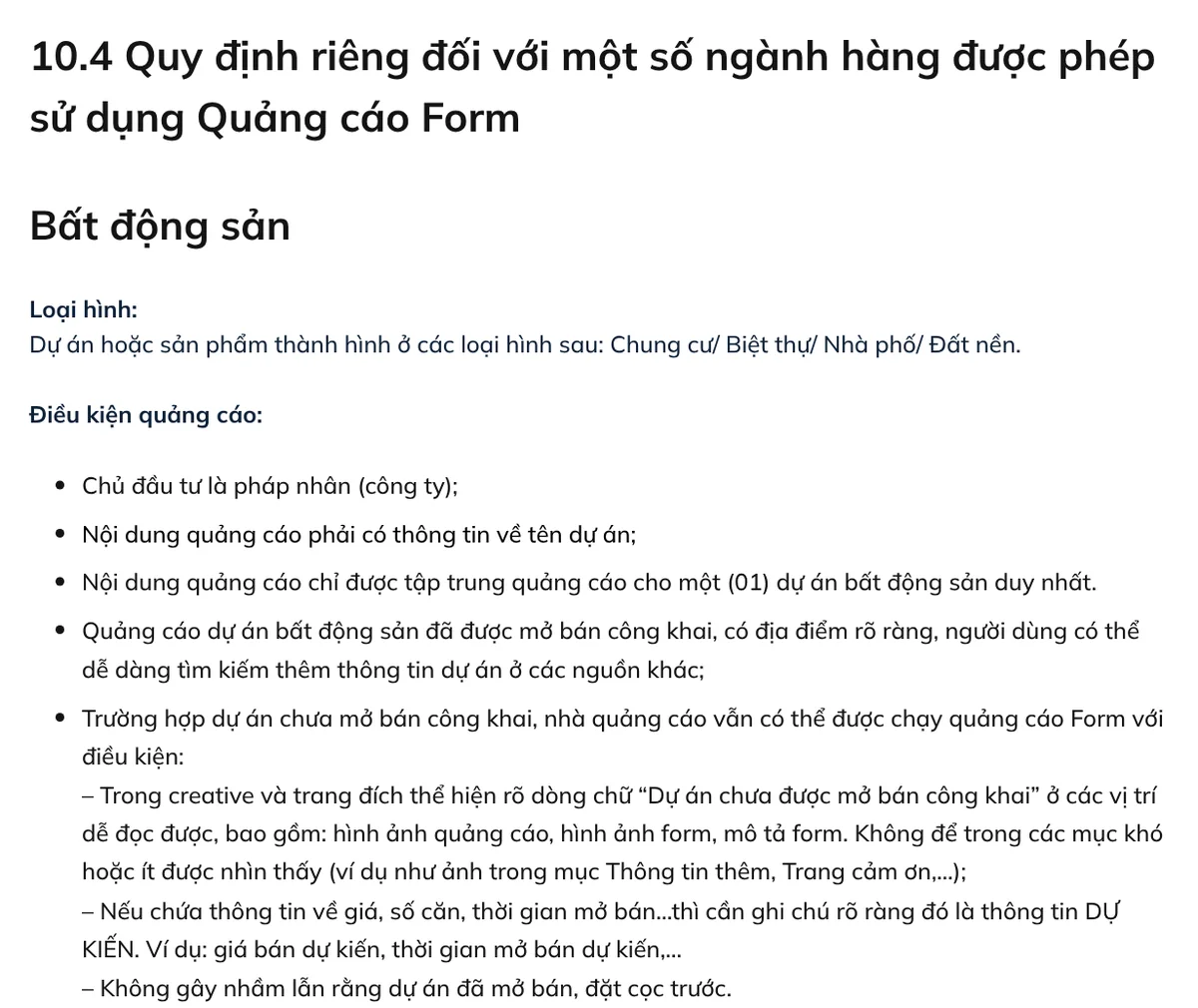
Real estate investment companies, brokerage companies and services, and property listing websites cannot use Form ads yet (Zalo Ads, Form ad rules). A brokerage collecting leads on Zalo should send people to a Zalo OA or a landing page instead.
Vietnam’s 2023 Real Estate Business Law and ad content
This section is not legal advice on advertising law. It lists only the articles of the Law on Real Estate Business 2023 (No. 29/2023/QH15) that bear directly on ads, forms and landing pages.
- Article 6, disclosure. Before selling, the developer must publish project information on the national housing and real estate market information system and on its own website: investment approval, land allocation decision, detailed zoning plan, model contract, and for off-plan housing also the construction permit and the guarantee agreement (Vietnam Lawyers Journal, February 2024).
- Article 8, prohibited acts: selling property that does not meet the legal conditions, distorting project information, failing to disclose information, collecting payments for off-plan housing in breach of the law.
- Article 23(5), deposits: a developer may collect a deposit of no more than 5% of the sale price, and only once the housing meets the conditions for sale. Article 17(4): the developer may not authorize anyone else to sign deposit contracts (Vietnam Lawyers Journal citing the Ministry of Construction, January 2026).
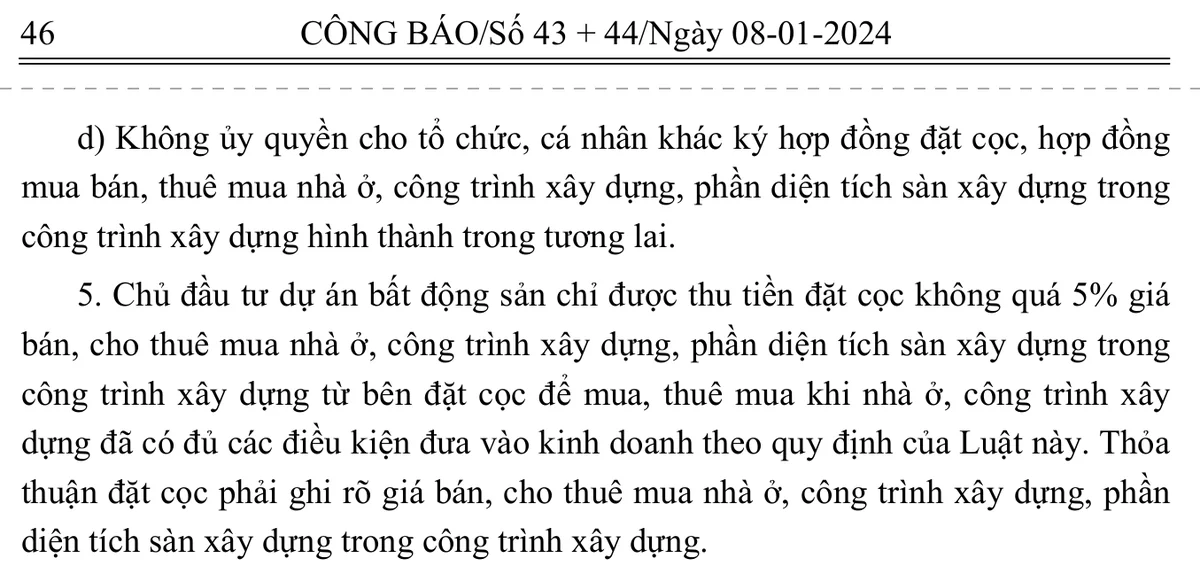
For whoever runs the ads, that means three things: if the project is not yet eligible, do not write “deposits accepted” or “refundable reservation”; link the landing page to the legal disclosure section; keep the advertised price consistent with the model contract.
Buying real estate lead lists: don’t
The Vietnamese query for “real estate customer data” gets about 320 searches a month, and “buy customer data” another 260 (Google Keyword Planner, October 2026). Do not buy. Vietnam’s Personal Data Protection Law, in force since January 1, 2026, bans buying and selling personal data, with fines for organizations of up to 10 times the revenue gained or 3 billion VND (see Vietnam’s personal data protection law). Purchased lists have also been called by a dozen brokerages before you. First-party data that buyers gave you, with consent, is what you can reuse for the next project.
Real estate ad channels by role
| Channel | Role | Notes |
|---|---|---|
| Google Search | Capture people searching the project name, “apartments + district”, the developer’s name | Capped by real search volume |
| Meta lead ads, Messenger | Expansion: reach people who are not searching yet, screen by form or chat | SMS verification; someone must answer messages |
| Zalo | Zalo Form (developers only), Zalo OA for follow-up, ZNS for visit reminders | Subject to the Form conditions above |
| Website, SEO | Project pages, legal pages, neighborhood analysis | Slow, but no cost per click |
Google lead form assets work with Search and Performance Max, but Google keeps leads for only 60 days and lets you download CSV files for the last 30 days; push leads to the CRM via webhook, API or Zapier (Google Ads Help, About lead form assets). If you want Google to expand queries around the project name, see how Google AI Max for Search works.
Meta’s Automated chat template asks screening questions in Messenger before asking for a phone number, and Meta uses a realtor as its own example (Meta, Lead generation in Messenger). The project page on your website is where buyers check the legal status before calling; write it the way you would approach B2B SEO: answer the questions buyers actually ask, with an author and sources.
Screening forms for real estate leads
Meta’s Higher intent instant form adds a line saying the business may follow up and a review screen where people confirm their details; it only runs in Facebook Feed and Instagram Feed on mobile (Meta, About instant form types). A form can hold up to 15 custom questions, conditional logic, and an option to require SMS verification when the phone number is a required field (Meta, Create a lead ad with instant form in Meta Ads Manager). SMS verification is the cheapest way to cut lead fraud.
The form formula I use for apartment projects:
[Live in or invest] + [Unit type] + [Budget band] + [Purchase timing] + [Current district]
- Are you buying to live in, or to invest and rent out?
- Which unit type interests you? (1 bedroom, 2 bedrooms, 3 bedrooms, Duplex)
- Expected budget? (Under 3 billion, 3 to 5 billion, Over 5 billion)
- When do you expect to buy? (Within 3 months, 3 to 6 months, Just researching)
- Which district does your family live in now?
Budget bands follow the price list. The district question is for routing leads, not for rejecting them.
What not to do on a real estate form:
- Ask “Would you like a 10% discount?”. It attracts gift hunters.
- Write “Reserve your unit now” when the project is not yet eligible for sale.
- Ask for monthly income. Real buyers abandon the form too.
- Combine two questions: “How many bedrooms and which floor?”.
Forms on a landing page use the same formula; a real estate landing page also needs a price band and a legal section.
Real estate CRM: from ad to transaction
When buyer records live in each salesperson’s Excel file, nobody knows which buyers have not been called and which ones got two calls. A CRM is like the shared logbook at a front desk: anyone who opens it sees where each buyer stands.
Five lead handling rules
- Leads enter the CRM automatically from Meta, Google, Zalo and the website, with no manual downloads.
- Lead routing follows fixed rules (project, unit type, district), with a timestamp so distribution agencies do not fight over leads.
- First call as soon as possible during working hours, because buyers often fill in forms for several projects in one evening. Call back 3 times at 3 different times of day before marking “unreachable”.
- Deduplication by phone number: one number filling several forms within 30 days counts as one lead, keeping first and last source.
- Update the status the same day, right after the call or the site visit.
Lead stages: New lead, Contacted, QL, Visit booked, Visited, Deposit (once the project is eligible), Contract signed, Not qualified.
Sending CRM status back to Meta and Google
Send “form submitted” and the algorithm finds people who like filling in forms. Send “visited the project” and it finds people like your site visitors. On Meta, choose the Maximize number of qualified leads performance goal and connect your CRM through the Conversions API. Since April 2026, new campaigns cannot use this goal without a Conversions API integration; existing campaigns are affected from August 2026. In a test Meta published (567 advertisers with Conversions API for CRM, January 13 to 27, 2025), this goal with instant forms produced a 21% lower cost per quality lead than Maximize number of leads; Meta states results are not guaranteed (Meta, About performance goals for lead ads). During the learning phase, send an event every time a lead changes status (Meta, Set up your CRM).
On Google, enhanced conversions for leads uses hashed email and phone numbers from the form to match CRM conversions to ads; from June 15, 2026, these uploads move to the Data Manager API (Google Ads Help, About enhanced conversions for leads). Set “Visited the project” as the primary conversion action and “Form submitted” as secondary.
Tasks for the tech team
| Task | Platform | How to check |
|---|---|---|
| Send instant form and website form leads to the CRM, store Meta’s lead ID | Meta | Create a test lead in Events Manager and see it in the CRM |
| Send lead stages via Conversions API for CRM | Meta | Change a test lead’s status and see the event in Test events |
| Connect lead form assets to the CRM via webhook | Send test data from the webhook setup screen | |
| Turn on enhanced conversions for leads, upload “Visited the project” | Diagnostics report shows no errors |
First and last source keep the last channel from taking all the credit; the next step up is multi-touch attribution.
Real estate lead generation worksheet from units to sell
Work backward from units, not forward from last project’s budget. Take the rates in steps 2 to 4 from your CRM for the previous sales phase.
| Step | Formula | Example (hypothetical) | Your project |
|---|---|---|---|
| 1. Transactions needed from digital | Units to sell x digital share | 120 x 40% = 48 units | |
| 2. Site visits needed | Transactions / site visit to transaction rate | 48 / 8% = 600 visits | |
| 3. QLs needed | Site visits / QL to site visit rate | 600 / 25% = 2,400 QLs | |
| 4. Leads needed | QLs / lead to QL rate | 2,400 / 30% = 8,000 leads | |
| 5. Media budget | QLs x target CPQL | 2,400 x 1.2 million = 2.88 billion VND | |
| 6. Calling capacity | Leads / months / salespeople | 8,000 / 6 / 20 = 67 leads per salesperson per month | |
| 7. Cost per transaction | Budget / transactions | 2.88 billion / 48 = 60 million VND |
Step 6 is the one people skip: if sales cannot call fast enough, leads go cold. Compare step 7 with the margin per unit to see whether your CAC is acceptable (how to read it in growth marketing metrics).
Checklist before running real estate ads
- Project information is published on the website and the landing page links to it; if the project is not yet eligible, no deposit or reservation wording.
- Campaigns for overseas Vietnamese in the US, Canada and Europe run separately under the Housing Special Ad Category.
- Forms have screening questions, SMS verification, a privacy policy and consent text; no purchased phone lists.
- Leads from every channel enter the CRM automatically, with routing and deduplication rules.
- QL and “Visited the project” statuses are sent to Meta and Google.
- The weekly report shows CPQL and cost per site visit by channel, plus reasons leads were rejected.
Short on QLs, so raise the budget? Yes, if sales can still keep up and cost per site visit is under target. No, if leads are sitting untouched in the CRM; then fix the form, call speed and the signals sent to the platforms first (for how Meta delivers ads, see Meta Andromeda).
If your project needs a review of its screening forms and the lead path from ads to CRM before launch, see how Adtek handles lead generation or contact Adtek.
Sources
- Meta Business Help Center (accessed October 30, 2026). About ads for housing; About audiences for housing, employment or financial products and services campaigns; Lead generation in Messenger with third-party messaging apps.
- Meta Business Help Center (continued). About instant form types; Create a lead ad with instant form in Meta Ads Manager; About performance goals for lead ads (April 2026); Set up your CRM for qualified leads.
- Google Ads Help (accessed October 30, 2026). Personalized advertising; About lead form assets; About enhanced conversions for leads (June 2026).
- Zalo Ads. Quy định về sử dụng Quảng cáo Form (Form ad rules), sections 10.4 and 10.5 (updated September 18, 2026, accessed October 30, 2026).
- Vietnam Lawyers Journal (Báo Luật sư Việt Nam). Công khai thông tin về bất động sản trước khi đưa vào kinh doanh (February 13, 2024); Đặt cọc mua nhà hình thành trong tương lai thế nào là đúng quy định? (January 2, 2026).
- Google Ads Keyword Planner, Vietnam, Vietnamese language, checked October 30, 2026.
Want to apply this to your business?
Send your question or situation. The Adtek team reads every question and gets back to you.
Prefer to chat? Message us on Zalo Categories
 Recent Posts