ENG
 VIE
 +84 9323 494 34


FMCG ecommerce in Vietnam 2026: selling everyday essentials on Shopee and TikTok Shop and winning repeat buyers
 November 12, 2026
 Tin Le
Contents
In Q3 2026, FMCG sales on Vietnam’s e-commerce marketplaces grew 36% year on year, the fastest of any category YouNet ECI tracks. On TikTok Shop alone, FMCG GMV grew 67%, three times Shopee’s pace (YouNet ECI, October 2026). FMCG ecommerce has its own math: small baskets, platform fees charged per order, and profit that usually arrives only with the second purchase. By the end you will have a simple sheet that tells you how many times a customer has to come back before a store earns back its ad spend.
What is FMCG, and why does it sell differently on marketplaces?
FMCG (fast-moving consumer goods) are products people use up in days or weeks and then buy again. Here I group four categories that sell well on Vietnamese marketplaces: beverages, personal care, household cleaning, and mother and baby (diapers, wet wipes, milk). Compared with fashion or cosmetics, FMCG on Shopee and TikTok Shop has three traits. I number them so I can refer back later:
- Repeat purchases on a cycle. When a bag of laundry detergent runs out, the customer buys another one, from your store or from the store next to it.
- Small baskets. Many orders are worth a few tens of thousands to a few hundred thousand dong, while some platform fees are a fixed amount per order.
- Price comparison. Dozens of stores sell the same bottle of shampoo, and a gap of a few thousand dong is enough for a shopper to switch.
Think of the corner grocery store in a Vietnamese alley. The profit is not in the first pack of detergent; it is in the whole neighborhood stopping by every week. Selling everyday essentials on a marketplace works the same way.
FMCG ecommerce on Shopee and TikTok Shop in 2026: the latest data
In 2025, FMCG grew 38% and became the second-largest category across Vietnam’s four main marketplaces. TikTok Shop’s share of FMCG rose from 28% to 37% (YouNet ECI, reported by VnBusiness, March 2026). Platform fees went up throughout the second half of 2025, yet FMCG unit sales held level with the year before (Vietnamnet, February 2026).
| FMCG metric (YouNet ECI) | Shopee | TikTok Shop |
|---|---|---|
| Market share, 2025 | 57% | 37% |
| GMV, Q4 2025 to Q1 2026 | VND 12.5 trillion down to 12.3 trillion | VND 7.6 trillion up to 8.7 trillion |
| GMV, Q3 2026 | VND 15.9 trillion | VND 12.5 trillion |
| Growth, Q3 2026 year on year | 22% | 67% |
The category as a whole reached VND 29.4 trillion in GMV in Q3 2026. The growth came from both price (17%) and units sold (18%), while fashion and beauty started to stall on order volume (YouNet ECI, October 2026). Over the first nine months, FMCG grew 26% (YouNet ECI, October 2026).
In plain terms, shoppers are buying more items, and the growth is not all price inflation. Shopee is still where regular customers go back to search, and TikTok Shop is pulling new customers into the category fastest. How to split roles and budget between the two platforms by category is covered in TikTok Shop vs Shopee.
How Shopee and TikTok Shop fees eat into small baskets
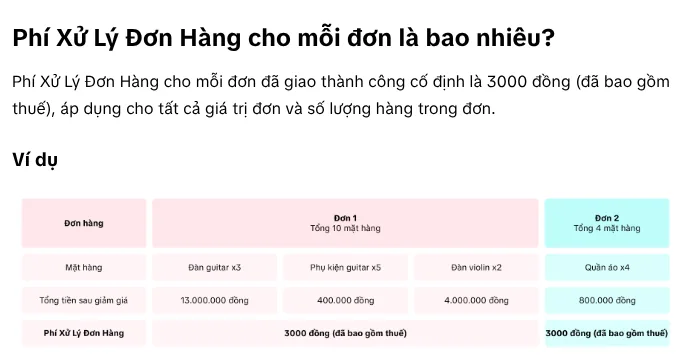
For FMCG, the scariest charge is the fixed fee per order. Since October 27, 2025, TikTok Shop has charged an Order Processing Fee (Phí Xử Lý Đơn Hàng) of VND 3,000 on every successfully delivered order, and it is not refunded even if the customer returns the goods later (TikTok Shop Academy). Look at the last row of the example table in the screenshot below: an order with 10 items and an order with 4 items both pay exactly VND 3,000.
Shopee has charged an infrastructure fee of VND 3,000 per order since July 1, 2025, including on return and refund requests it has accepted (Báo Pháp luật Việt Nam, June 2025). How much that hurts depends on the order value:
| Order value | Share taken by VND 3,000 |
|---|---|
| VND 50,000 | 6% |
| VND 100,000 | 3% |
| VND 200,000 | 1.5% |
| VND 400,000 | 0.75% |
A VND 50,000 order loses 6% to the fixed fee alone. That is why trait (2) is the number one problem for FMCG on marketplaces.
On top of that come percentage fees. TikTok Shop has charged a 6% transaction fee since May 9, 2026 (TikTok Shop Academy, updated October 13, 2026), plus a platform commission that varies by category. Some current rates (TikTok Shop Academy, September 30, 2026):
| Category | Mall sellers (from October 20, 2026) | Standard sellers (from July 3, 2026) |
|---|---|---|
| Laundry detergent | 12.7% | 9.0% |
| Shampoo and conditioner | 18.8% | 15.5% |
| Toothpaste | 18.8% | 15.0% |
| Diapers (mother and baby) | 14.5% | 11.0% |
| Instant noodles | 11.7% | 8.5% |
Shampoo sold through a TikTok Shop Mall store pays an 18.8% commission; add the 6% transaction fee and close to 25% of the price is gone before any advertising. Shopee also charges a category-based fixed fee and, since May 1, 2026, a 6% transaction processing fee (MISA eShop summary, 2026). How to work out a break-even price after fees is in our 11.11 plan for Shopee and TikTok Shop.
Splitting roles when you sell on Shopee and TikTok Shop
Selling on Shopee is like putting your product on a familiar shelf. The shopper types “nước giặt” (laundry detergent) or “tã quần size L” (size L pull-up diapers) and picks the store they bought from last time. Shopee ad money should defend brand keywords and category keywords with purchase intent. A Shopee Mall store reassures shoppers that the goods are genuine, which is the first thing people buying diapers or milk ask about.
On TikTok Shop, the shopper had no plan to buy. They watch a KOC wash out a tough stain, or a young mother compare two diaper brands, and then they check out. TikTok Shop is the place to bring in new customers, launch new SKUs and sell bundles, and GMV Max needs plenty of good videos before it has anything to deliver. How each platform charges for ads is explained in marketplace advertising in Vietnam.
Clients often ask me whether they should discount heavily on TikTok Shop to win customers. Yes, if you already have a way to bring that customer back for a second order. No, if your store has none of the tools in the next section in place.
5 ways to win repeat buyers on Shopee and TikTok Shop
Your store operations team sets these up in Shopee Seller Centre and TikTok Shop Seller Center. I only cover which tool to use and when.
1. Bundles that make the basket bigger
Bundles solve trait (2). Shopee’s Combo khuyến mãi (bundle deal) lets you set offers such as “Mua 2 & giảm 10%” (buy 2, get 10% off), and the two units can be different products from the same store. If a product is in a flash sale, its bundle deal is paused (Shopee Help Center). In the screenshot below, the “Mua 2 & giảm 10%” tag sits right next to the product price.
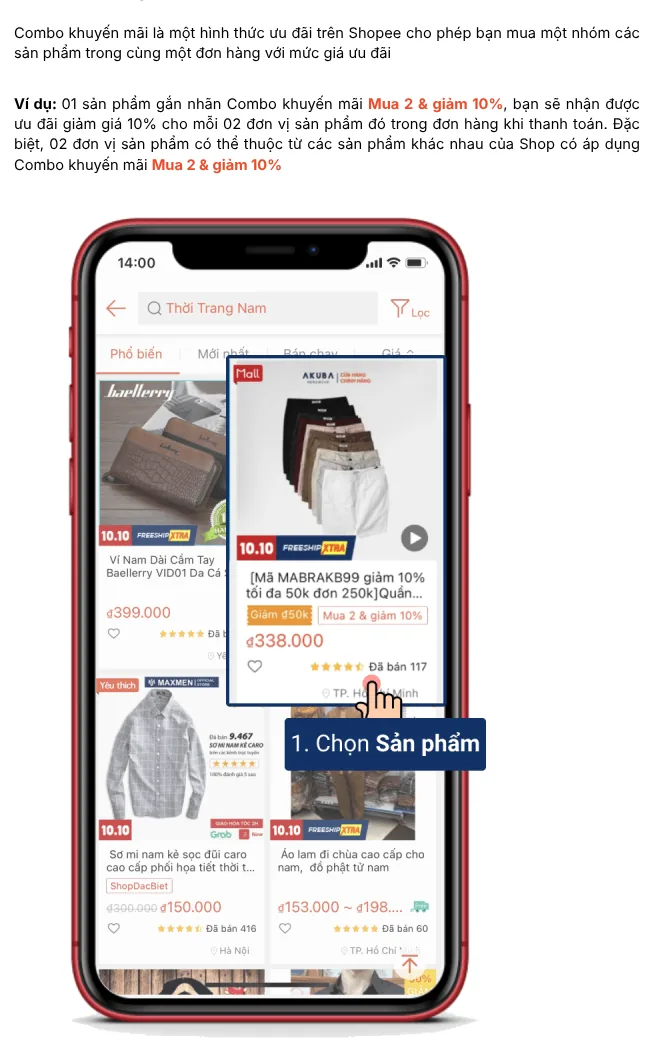
Shopee also has Mua Kèm Deal Sốc (add-on deal): buy the main product and you can add another item at a discount or receive a free gift (Shopee Help Center). TikTok Shop offers Ưu Đãi Theo Gói (bundle deals), which group 2 to 3 products at a fixed price or a percentage discount (TikTok Shop Academy), and Mua Sỉ Giá Hời (buy more, save more), a quantity discount with up to two tiers (TikTok Shop Academy).
When AOV (average order value) goes up, the fixed fee weighs less: a VND 359,000 order pays VND 3,000, or 0.8%, instead of 1.6% on a VND 189,000 order. Build FMCG bundles around how people use the products: detergent with fabric softener, shampoo with conditioner, diapers with wet wipes.
2. Monthly packs instead of a subscription
I have not found any official Shopee or TikTok Shop Vietnam documentation on a subscription feature (automatic recurring orders and payments) for sellers. The workaround is a SKU sized by how long it lasts: a “1-month pack” with 2 bags of detergent, a “3-month pack” with 6 bags, with the price per bag falling as the pack gets bigger. A shopper who reads “enough for 3 months” gets it instantly; “6 bags” makes them do the math.
3. Vouchers timed to the usage cycle
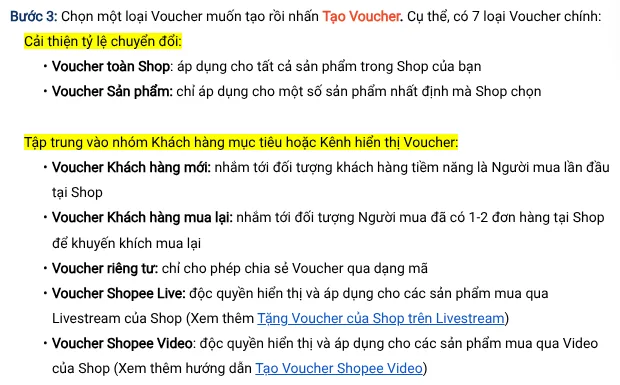
Repeat-buyer vouchers solve traits (1) and (3): the customer has a reason to return to the same store instead of comparing prices from scratch. On Shopee, the Voucher Khách hàng mua lại (repeat buyer voucher) targets shoppers who have placed 1 to 2 orders with your store. It can run for up to 3 months, each buyer can use it once by default, and you can send the code through Shopee Chat or a broadcast message (Shopee Uni). The screenshot below shows Shopee’s 7 store voucher types; this one sits in the second group.
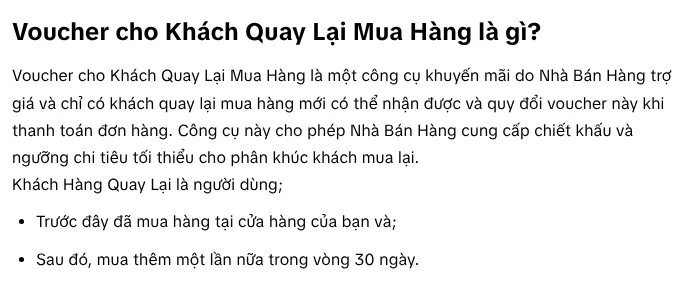
On TikTok Shop, the Voucher cho Khách Quay Lại Mua Hàng (returning customer voucher) can only be claimed and used by returning customers, and you set the discount, the minimum spend and the number of claims per buyer (TikTok Shop Academy). The help page defines a returning customer as someone who has bought from your store and then buys again within 30 days, as the screenshot below shows.
For products that last longer than 30 days, use Mua Sỉ Giá Hời and pick the customer group “Khách hàng hiện tại” (existing customers, at least 1 past order) or “Khách mua tiếp” (repeat buyers, 2 or more orders). Sending vouchers through bulk CRM messages is currently open only to some sellers (TikTok Shop Academy).
Timing matters more than the discount. If a bag of detergent lasts about 30 days (an assumption for a family of four), send the voucher on day 24 to 26 after the first order, valid for 7 to 10 days. Sending it right after the first order wastes money, because the customer does not need to buy yet.
4. Store follows as a channel for reminders
Shopee’s Ưu Đãi Follower (follower offer) is a discount code for shoppers who follow your store for the first time. They claim it on the store’s home page or during a livestream in the Shopee app (Shopee Help Center). Followers get notified when the store goes live or runs an offer (Shopee Blog, July 2026). Follows also solve trait (1): every follower is a reminder channel that costs nothing in ad spend.
On TikTok Shop, Mall sellers can send customized CRM broadcast messages with a voucher or product attached to a chosen customer group. If customers complain about a message, the store receives a violation warning (TikTok Shop Academy). Send few messages, timed to the cycle in point 3.
5. Shopee Live and regular livestreams for loyal customers
An FMCG livestream does not need a new product every time. I set a fixed schedule that follows the usage cycle, for example the evening of the 25th every month, with a bundle that is only available during the stream. Shopee has a Voucher Shopee Live that applies only to products bought through the store’s livestream (Shopee Uni); on TikTok, LIVE GMV Max pushes the stream to people who do not know the store yet. A script and a profit and loss calculation for a single session are in our guide to livestream selling.
The marketplace keeps the customer data. A loyalty program with points and membership tiers of your own has to run on the brand’s website or its own channels.
Worked example: how many times must a detergent buyer come back?
This is a hypothetical example, not data from a real client. I sell a 3.6 kg bag of laundry detergent through a TikTok Shop Mall store at VND 189,000, with a cost of goods of VND 95,000. To keep the math simple, shipping is free for the customer and the transaction fee is calculated on the selling price.
Step 1: profit per order before advertising. The 12.7% commission is VND 24,003, the 6% transaction fee VND 11,340, the order processing fee VND 3,000 and packaging VND 5,000 (assumed). That leaves VND 50,657 per order.
Step 2: subtract CAC. Assume a CAC (customer acquisition cost) of VND 80,000 in ad spend. The first order loses VND 29,343.
Step 3: later orders with a voucher. The returning customer uses a VND 15,000 voucher and pays VND 174,000. After a commission of VND 22,098, a transaction fee of VND 10,440, the processing fee and packaging, the order makes VND 38,462. A customer who buys twice leaves a cumulative profit of VND 9,119; three times, VND 47,581.
Step 4: multiply by the repeat rate. Assume 1,000 new customers this month, which we call a cohort (customers grouped by the month of their first purchase). 35% buy a second time, 60% of those buy a third time, and 70% of the third-time buyers buy a fourth time.
| Purchase | Customers | Profit on that purchase (VND million) | Cumulative (VND million) |
|---|---|---|---|
| 1 | 1,000 | Loss of 29.3 | Loss of 29.3 |
| 2 | 350 | 13.5 | Loss of 15.9 |
| 3 | 210 | 8.1 | Loss of 7.8 |
| 4 | 147 | 5.7 | Loss of 2.2 |
After four purchases, this cohort is still about VND 2.2 million in the red. If the second-purchase rate rises to 45% and the later rates stay the same, the same cohort ends about VND 5.6 million in profit.
Step 5: work out the maximum CAC. At a 35% repeat rate, 1,000 new customers generate 707 repeat orders, or 0.707 per customer. The maximum CAC is 50,657 + 0.707 × 38,462, roughly VND 77,800. At 45%, it is roughly VND 85,600. Raising the repeat rate by 10 percentage points lets you pay about VND 7,800 more for each new customer and still break even after four purchases.
Step 6: try a bundle. A 2-bag bundle at VND 359,000, with a cost of goods of VND 190,000 and packaging of VND 6,000, makes VND 92,867. After the VND 80,000 CAC, VND 12,867 is left on the very first order. The bundle pulls the second purchase into the first order, so I tend to make the bundle the product I advertise to new customers.
Copy these three formulas into a spreadsheet and plug in your own store’s numbers:
- Profit per order = selling price minus cost of goods, commission, transaction fee, fixed per-order fee and packaging.
- Average repeat purchases = orders from the second purchase onward in a cohort / new customers in that cohort.
- Maximum CAC = first-order profit + average repeat purchases × profit per repeat purchase.
A repeat-purchase framework for FMCG categories
Take the usage cycle from your own store’s order data: the number of days between the first and second order among customers who did come back.
| Category | Bundle to build | Monthly pack | Repeat reminder |
|---|---|---|---|
| Beverages | Several flavors in one case | 2-week or 1-month case | Returning customer voucher before the case runs out |
| Personal care | Shampoo with conditioner | Large size, 2-bottle set | Regular livestreams |
| Household cleaning | Detergent with fabric softener | 1-month and 3-month packs | Broadcast message with a voucher |
| Mother and baby (diapers, wipes) | Diapers with wet wipes | Packs by size | Reminder to size up as the baby grows |
Milk for young children is a special case. Vietnam’s Decree 100/2014/ND-CP bans advertising breast milk substitutes for children under 24 months (Article 6) and bans promotions on breast milk substitutes, including discount vouchers, gifts, loyalty points and price cuts (Article 11) (Decree 100/2014/ND-CP). Check with your legal team before putting these products in a bundle or voucher.
What not to do when building FMCG repeat purchases
- Sending a repeat voucher right after the first order. Wrong: a customer who received the detergent yesterday gets a VND 15,000 code that expires in 3 days.
- Running ads before you know your maximum CAC. Wrong: paying VND 100,000 per new customer when the sheet allows VND 77,800.
- Buying fake followers. Followers who do not exist never see your livestream notifications.
- Cutting new-customer ads because first-order ROAS (return on ad spend) is low. Losing money on the first order is normal if the cohort breaks even by the third or fourth purchase.
Which metrics show that customer retention is working?
Beyond the GMV and ROAS the platform reports per campaign, calculate these from your monthly order export:
- Retention rate by cohort: what share of new customers buy again within 30, 60 and 90 days. The rest is your churn rate.
- LTV (lifetime value) measured in profit, not revenue.
- Conversion rate of repeat vouchers: codes used divided by codes issued.
How to put these numbers next to CAC in a monthly report is covered in growth marketing metrics; the preparation calendar for peak season is in our Tet marketing plan.
Adtek runs Shopee Ads and TikTok GMV Max campaigns for brands and does not operate marketplace stores; if you want your ad budget recalculated around the value of repeat buyers, see Adtek’s e-commerce solution or contact the Adtek team.
Sources
- YouNet ECI (October 2026). TikTok Shop thu hẹp khoảng cách GMV với Shopee (October 23); Báo cáo Doanh thu & Tiêu dùng TMĐT Việt Nam Q3/2026 (October 20); Báo cáo TMĐT Việt Nam Q3/2026 (October 14).
- VnBusiness (March 2026). Shopee giữ ngôi đầu, TikTok Shop tăng tốc trên thị trường thương mại điện tử Việt Nam.
- Vietnamnet (February 2026). Online shopping rises 26%, but easy growth is over.
- TikTok Shop Academy. Order Processing Fee (October 2025); Transaction Fee (October 2026); Platform Commission Fee (September 2026).
- TikTok Shop Academy. Returning customer voucher (February 2025); Bundle deals (April 2024); Buy more, save more (December 2025); Targeted vouchers via bulk CRM messages (June 2025); Customized CRM broadcast messages (August 2024).
- Shopee (accessed November 2026). How to create store vouchers; Bundle deals; Add-on deals; Follower offers; Shopee Blog (July 2026) How to grow Shopee followers.
- Báo Pháp luật Việt Nam (June 2025). Shopee áp thu phí hạ tầng 3.000 đồng/đơn hàng kể từ ngày 1/7.
- MISA eShop (2026). Các loại phí sàn Shopee 2026.
- Government of Vietnam (November 2014). Decree 100/2014/ND-CP on the trading and use of nutritional products for young children.
Want to apply this to your business?
Send your question or situation. The Adtek team reads every question and gets back to you.
Prefer to chat? Message us on Zalo Categories
 Recent Posts